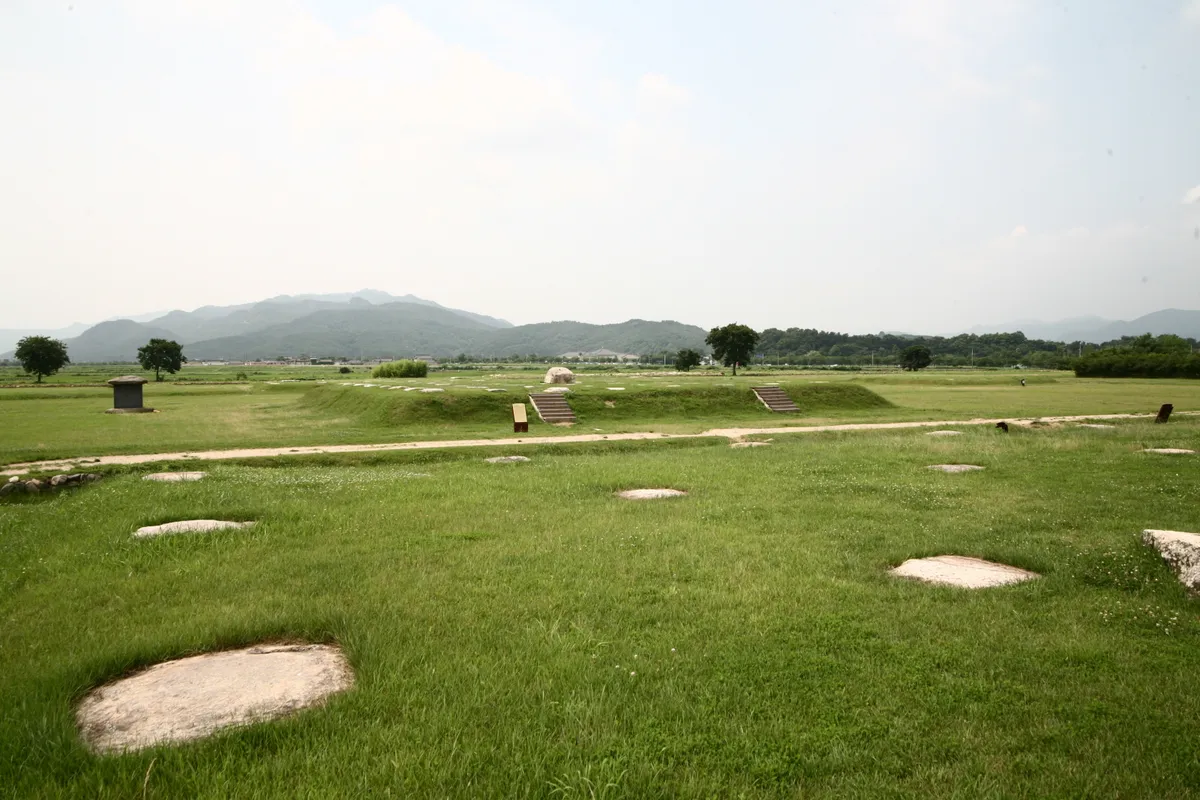
Hwangnyongsa Temple Site, Gyeongju
慶州 皇龍寺址
경상북도 경주시
Basic information
- Designation
- Historic Site No.6
- Category
- 유적지
- Era
- 신라 진흥왕 14년(553)
- Designated year
- 1963
- Location
- 경주시, 경상북도— 경북 경주시 구황동 320-1번지
- Coordinates
- 35.835728, 129.230773
AI Docent
✨ AI-generatedWelcome to Hwangnyongsa Temple Site! Imagine standing here over 1,400 years ago, when Silla's greatest rulers commissioned this magnificent complex to honor a yellow dragon and seek Buddha's protection. Construction began in 553 and took an astounding 93 years to complete—a testament to its importance. The temple's crowning glory was its Nine-story Wooden Pagoda, finished in 645, which symbolized defense against nine enemies. This pagoda became one of Silla's three national treasures. The temple also housed a golden shrine with precious Buddhist statues crafted from materials gifted by India, and murals by the era's greatest artist. Though burned during the Mongol invasion in 1238, excavations since 1976 have unearthed about 40,000 artifacts—bronze statues, bells, ornaments, and ceramics from China—revealing this temple's wealth and international connections. You're standing on ground that shaped Korean Buddhism and statecraft.
⚠ This is an AI-generated retelling of the official description. For accuracy, refer to the official description below.
Description
The construction of Hwangnyongsa Temple, located east of Wolseong in Gyeongju, was begun in 553 during the reign of King Jinheung (540-576) of the Silla Dynasty to honor a yellow dragon that is said to have appeared at the building site. At the time of its completion in 574, Silla received models of Sakyamuni Buddha and his two acolytes, along with a vast amount of iron and gold, from India which, as the story goes, the great Indian king Asoka intended to use to make the statues of a Shakyamuni triad but failed. Silla was able to build a 5-meter-tall Shakyamuni triad with the precious metals, and in 584 erected a golden shrine hall in which to enshrine them. Later, a nine-story wooden pagoda was started in 643 on the advice of Jajang, a great priest of Silla, and was completed in 645 by a famous Baekje builder named Abiji. Silla’s rulers hoped that the pagoda would bring Buddha's aid for the protection of their kingdom against the nine foreign enemies symbolized by the nine stories of the pagoda. Hwangnyongsa Temple, which took 93 years to complete and eventually its Nine-story Wooden Pagoda became one of the three national treasures of Silla along with a sixteen-feet-high statue, which also was in the temple, and a jade belt bestowed by heaven. This great temple was, however, burnt down during the Mongol invasion of Korea (then Goryeo) in 1238. The remaining features of the temple show that it originally consisted of a middle gate, a wooden pagoda, a main prayer hall and a lecture hall arranged in a straight line, to which two more prayer halls, a bell tower and a scripture hall were added at a later date to form a wonderful symmetry. The temple was then enclosed by the huge structures of the gallery. According to Samguk yusa (Memorabilia of the Three Kingdoms), the temple also had a large temple bell, which is now missing. An excavation of the temple site started in 1976 produced a large collection of about 40,000 artifacts including gilt-bronze Buddhist statuettes, bells, ear ornaments, glass vessels and a huge 182-centimeter-long ornamental ridge-end tile. It is said that the temple also had a mural painted by Solgeo, who was admired as the greatest artist of his time, in its central prayer hall. The shards of a white porcelain jar from Tang China discovered at the wooden pagoda site constitute valuable tangible evidence of active exchanges between Silla and Tang.
Location
지도를 불러오는 중…
Have you visited this place?
Log in and verify your visit on-site via GPS to record a stamp in My Journey. (QR verification coming later.)
Images: KOGL (khs.go.kr) · Data source: Korea Heritage Service Open API (khs.go.kr)