Sacheonwangsa Temple Site, Gyeongju
慶州 四天王寺址
경상북도 경주시
Basic information
- Designation
- Historic Site No.8
- Category
- 유적지
- Era
- 통일신라 문무왕19년(679)
- Designated year
- 1963
- Location
- 경주시, 경상북도— 경북 경주시 배반동 935-2번지
- Coordinates
- 35.819446, 129.242755
AI Docent
Coming soonAn AI-generated, friendly retelling of this heritage site is available in Korean. An English version is on our roadmap — for now, please see the official description below.
Description
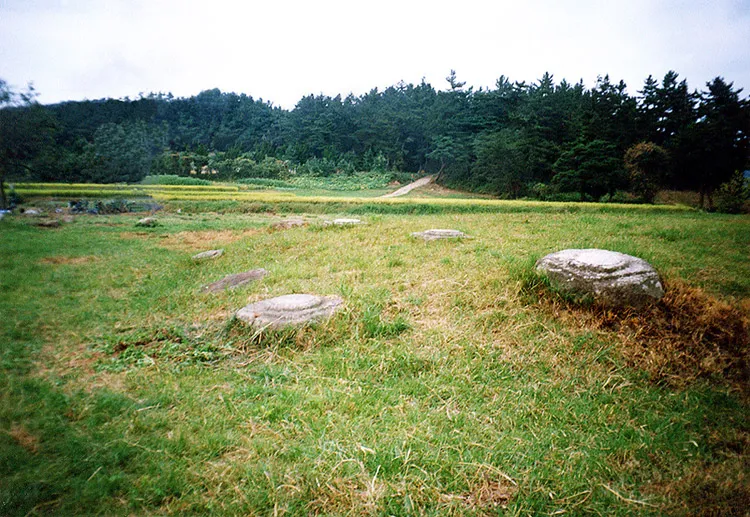
This temple site is located next to the royal tombs of King Sinmun and Queen Seondeok, which were built at the foot of Nangsan Mountain in Gyeongju. Construction of the temple began in 674 when evil tidings arrived that Tang China planned to send an army of half a million men across the sea to attack Silla, which had shown its hostility toward the Gyerim Commandery established by Tang in Silla territory. Astonished, Silla’s King Munmu (r. 661-681) sought the advice of Dharma Master Myeongnang and ordered to build a temple, which would later be Sacheonwangsa, in an effort to supplicate Buddha’s magical interruption. As the Tang forces were nearing Silla, the king ordered the yet-to-be-completed temple to be hidden with silk and grass and invited twelve eminent monks to perform the Mudra Rite of Esoteric Buddhism. The rite had a magical effect, causing a massive storm in the middle of the sea that devoured all the invading Tang vessels. The area where Sacheonwangsa Temple was built in 679 had long been considered a sacred place by Silla people. According to Samguk yusa (Memorabilia of the Three Kingdoms), Queen Seondeok (r. 632-647) left a will to the effect that she be buried in the Heaven of Thirty-three Gods after her death, indicating a site to the south of Nangsan Mountain. It was not until thirty years after the queen died that Sacheonwangsa Temple was built at the foot of Nangsan Mountain, which Silla people regarded as Mount Sumeru, the center of the Buddhist universe guarded by the Four Heavenly Kings. This reflects how deeply Buddhism influenced the Silla people’s way of thinking. The temple site contains two headless tortoise shaped pedestals that once supported stone monuments and a stone flagpole support. Of these, the stele pedestal located to the east of the temple has been widely praised for its realistic carving technique and its elaborate details, attesting to the high degree of artistic excellence achieved by Silla artisans. Known as the first temple to be built after the unification of the three Korean kingdoms by Silla, Sacheonwangsa Temple is a fine example of the “twin-pagoda layout” that characterizes the tradition of patriotism established in Silla Buddhism, and the Silla people’s view of humanity and the universe. The temple is also famous for its connection with the eminent monk Wolmyeong, who left behind two famous poems, Dosolga (Song of the Heaven of Joy) and Jemangmaega (Song for My Deceased Sister).
Location
지도를 불러오는 중…
Have you visited this place?
Log in and verify your visit on-site via GPS to record a stamp in My Journey. (QR verification coming later.)
Images: KOGL (khs.go.kr) · Data source: Korea Heritage Service Open API (khs.go.kr)