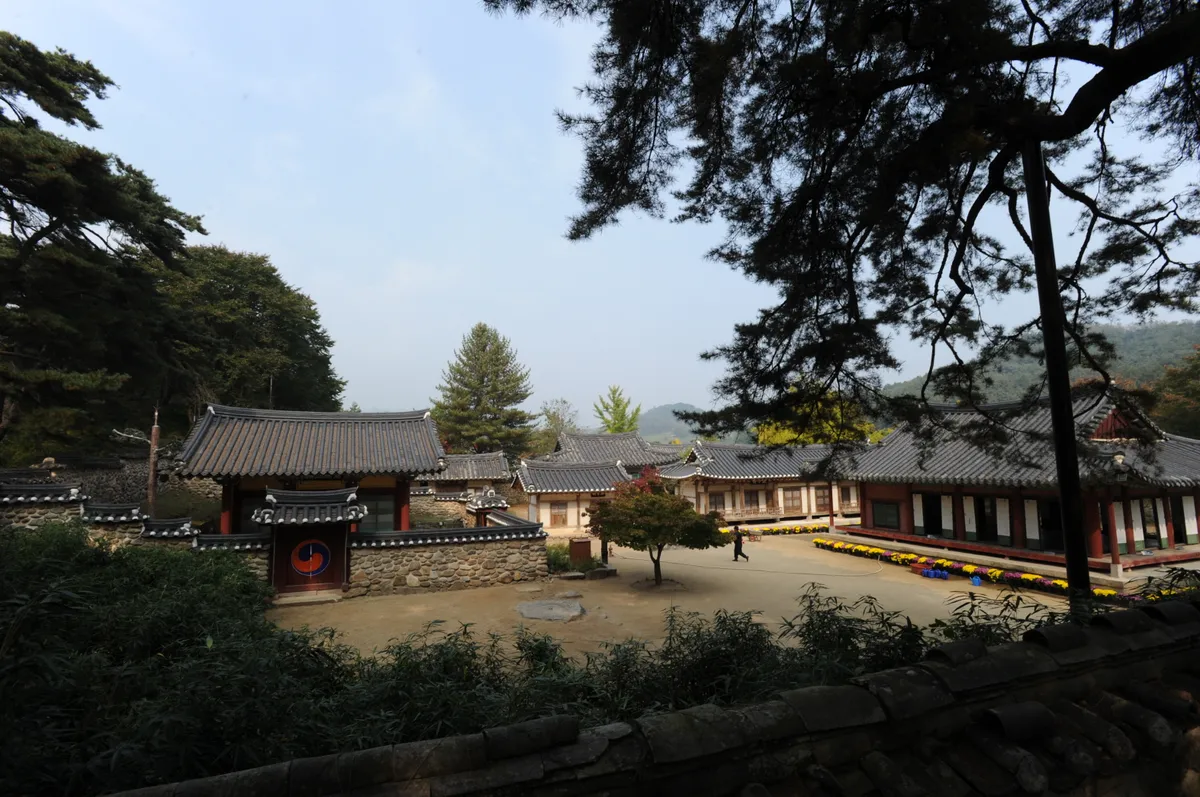
Sosu Seowon Confucian Academy, Yeongju
榮州 紹修書院
경상북도 영주시
Basic information
- Designation
- Historic Site No.55
- Category
- Architecture
- Era
- 조선 중종 38년(1543)
- Designated year
- 1963
- Location
- 영주시, 경상북도— 경북 영주시 순흥면 내죽리 151번지
- Coordinates
- 36.925306, 128.580563
AI Docent
✨ AI-generatedWelcome to Sosu Seowon, one of Korea's most historically significant Confucian academies! Imagine stepping into a place where education and honor intertwine—this academy, founded in 1541, became the very first private school to receive an official royal name from the throne. That's extraordinary. What makes Sosu Seowon truly special? It honors An Hyang, a brilliant Confucian scholar from centuries past. When the legendary philosopher Toegye served as county chief here, King Myeongjong renamed it in 1550, officially blessing it as Korea's first court-authorized private educational institute. You'll find beautifully arranged buildings here—a shrine, lecture halls, dormitories, and study spaces—all reflecting the academy's original architectural style. Notice the flagpole base outside; it marks where an ancient temple once stood. Today, Sosu Seowon remains one of only forty-seven academies to survive a major destruction order. Each spring and fall, ancestral ceremonies continue, keeping centuries of tradition alive. This is where Korean education and philosophy took root.
⚠ This is an AI-generated retelling of the official description. For accuracy, refer to the official description below.
Description
It is the first local private school whose name was bestowed by the throne. This Seowon, or Confucian academy, was first established as a memorial to An Hyang (1243-1306), a great Confucian scholar during the latter years of Goryeo (918-1392), by a local county chief, Ju Sebung, in 1541, the 36th year of the reign of King Jungjong (1506-44). It was called Baegundongseowon in 1543, the 38th year of the reign of King Jungjong, while it was used as a place for teaching students of Confucianism. King Myeongjong renamed the Sosuseowon in 1550 when Korea's greatest philosopher-scholar, Yi Hwang, better known as Toegye, was the county chief of this area. Thus, it became the first Seowon authorized by the Court and the first publicly accredited private educational institute. In 1544, the memorial tablets of scholars An Chuk (1287-1348) and An Bo (1302-1357) were enshrined; in 1633, the 11th year of the reign of King Injo (1623-49), the memorial tablet of founder Ju Sebung was enshrined here. This Seowon is thought to be an early form of Seowon according to the allocation of buildings and was somewhat freely located. Major facilities include the shrine, a lecture hall called Myeongnyundang, two dormitories, several study halls, and the archives. The shrine is located northwest of Myeongnyundang. The flagpole support and base just outside the main indicate that this place was originally the site of a temple called Suksusa. Sosuseowon is the first local private school whose name was bestowed by the throne and one of the forty-seven seowons remaining after the Seowon destruction ordered by King Daewongun of the late Joseon Dynasty (1392-1910). Here, an ancestral sacrifice is performed every spring and fall.
Location
지도를 불러오는 중…
Have you visited this place?
Log in and verify your visit on-site via GPS to record a stamp in My Journey. (QR verification coming later.)
Images: KOGL (khs.go.kr) · Data source: Korea Heritage Service Open API (khs.go.kr)