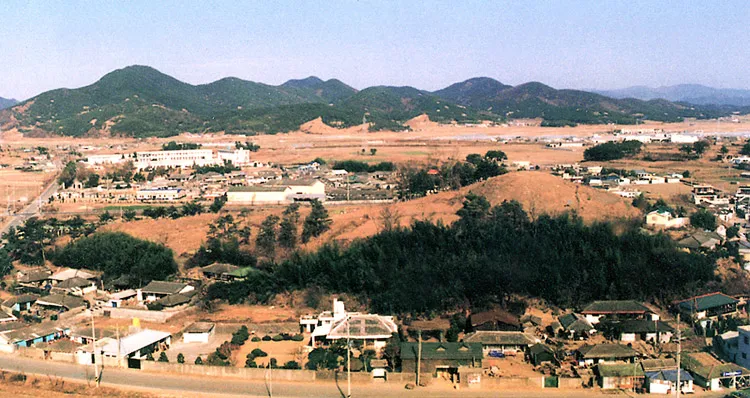
Songhak-dong Tumuli, Goseong
固城 松鶴洞 古墳群
경상남도 고성군
Basic information
- Designation
- Historic Site No.119
- Category
- 유적지
- Designated year
- 1963
- Location
- 고성군, 경상남도— 경남 고성군 고성읍 송학리 470번지 일원
- Coordinates
- 34.979667, 128.320133
AI Docent
✨ AI-generatedWelcome to Songhak-dong Tumuli, where you stand at the heart of ancient Gaya history! Imagine this hillside over 1,500 years ago: seven stone mounds clustered around Mugisan Mountain, each one a window into a fascinating kingdom. The centerpiece is the first mound—a drum-shaped tumulus with an inner stone chamber, representing classic Gaya style. Its impressive size and prominent location marked it as the most important burial here. Six other mounds arranged nearby served a dual purpose: they honored the first mound and protected it. What makes this site special? The artifacts tell Gaya's story. Nearby shell mounds have yielded bronze weapons, mirror fragments, and even carbonated rice seeds—evidence of a thriving Iron Age culture. These tombs weren't random; they reveal how sophisticated Gaya society was during Korea's Three Kingdoms Period. Standing here, you're literally walking through archaeology, surrounded by monuments that shaped Korea's heritage. The Gaya Kingdom's influence echoes in these stones.
⚠ This is an AI-generated retelling of the official description. For accuracy, refer to the official description below.
Description
These were seven old mounds around the hills of Mugisan Mountain, Goseong in the Gaya Era. The first tomb was laid on top, with the rest laid after the first one. Giwon-ri ancient burial mounds were located some 300 meters away, with the Songhak-dong shell mound located 300-400 meters away from this area. It hinted where the little Gaya Dynasty used to be during the Three Kingdoms Period. The first mound, whose inside was made up of rectangular stone room, was a drum-shaped tumulus. It represented the Gaya traditional style, since the main ground had no facilities. The seven mounds had a close relationship to the first one, the Mugisan Mountain ancient burial mound. They also served as protection of the first mound. The first mound was considered the best one judging from its great location and size. It was also assumed to have been built around 350 to 450. On the northeast is Goseong Dongoe-dong Shell Mound, where relics like Pit Tomb, Jar Coffin Tomb, and Stone Cist Tomb were located. In addition, remains like bronze spearhead, bronze hilt, mirror fragments, carbonated rice seeds, and gray vessel were found, indicating the culture of this area. As sources of important historical data, the tombs in Songhak-dong give clues to the level of Gaya culture, which was represented in the early Iron Age as the next culture.
Location
지도를 불러오는 중…
Have you visited this place?
Log in and verify your visit on-site via GPS to record a stamp in My Journey. (QR verification coming later.)
Images: KOGL (khs.go.kr) · Data source: Korea Heritage Service Open API (khs.go.kr)