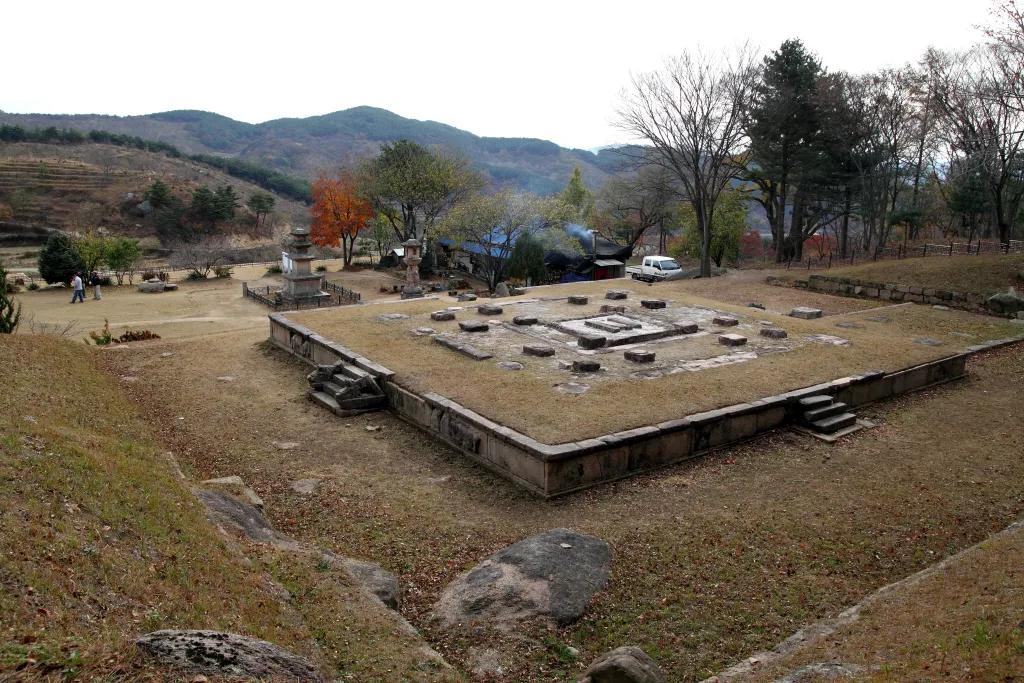
Yeongamsa Temple Site, Hapcheon
陜川 靈岩寺址
경상남도 합천군
Basic information
- Designation
- Historic Site No.131
- Category
- 유적지
- Era
- 고려시대
- Designated year
- 1964
- Location
- 합천군, 경상남도— 경상남도 합천군 가회면 둔내리 산 170-1
- Coordinates
- 35.474147, 128.003531
AI Docent
Coming soonAn AI-generated, friendly retelling of this heritage site is available in Korean. An English version is on our roadmap — for now, please see the official description below.
Description
Yeongamsa Temple Site was located at the southern foot of Hwangmaesan Mountain. The time of construction was not certain, but it was likely built before the 83-year-old Master Jeogyeon, a renowned Zen monk, entered Nirvana here during the Goryeo Dynasty (1014). The year of foundation could be estimated from the record of Stele for Master Honggak in the National Museum of Korea, since Yeongamsa Temple as recorded on the Stele for Master Honggak was built in 886. The size of the temple was estimated from the site of Geumdang Hall, which preserved bodhisattva, Seogeumdang Hall, and other building sites. Among them, Geumdang is known to have been restored three times. At the temple site, the Twin-lion Stone Lantern (Treasure No. 353) built during the Unified Silla Period, Three-story Stone Pagoda, Tortoise-shaped Pedestal, and tiles remain. In particular, the Gilt-bronze Standing Buddha built in the 8th century was an important clue for the year of construction. Unlike common temple buildings, the building site in Yeongamsa Temple had several features: stairs on each side of the middle projecting part of the embankment in Geumdang; face-shaped pattern engraved on the curbs in the site of Geumdang; animal statues engraved on the three sides except the back side, and; stairs on both sides of the pedestal at the southwest building site. Along with these features, stone architecture lying scattered at the temple site looked unique. The temple likely followed the typical style of esoteric Buddhism in the late Silla period, judging from the peculiar style of molding, geographical condition, and ashes around the southwest building site.
Location
지도를 불러오는 중…
Have you visited this place?
Log in and verify your visit on-site via GPS to record a stamp in My Journey. (QR verification coming later.)
Images: KOGL (khs.go.kr) · Data source: Korea Heritage Service Open API (khs.go.kr)