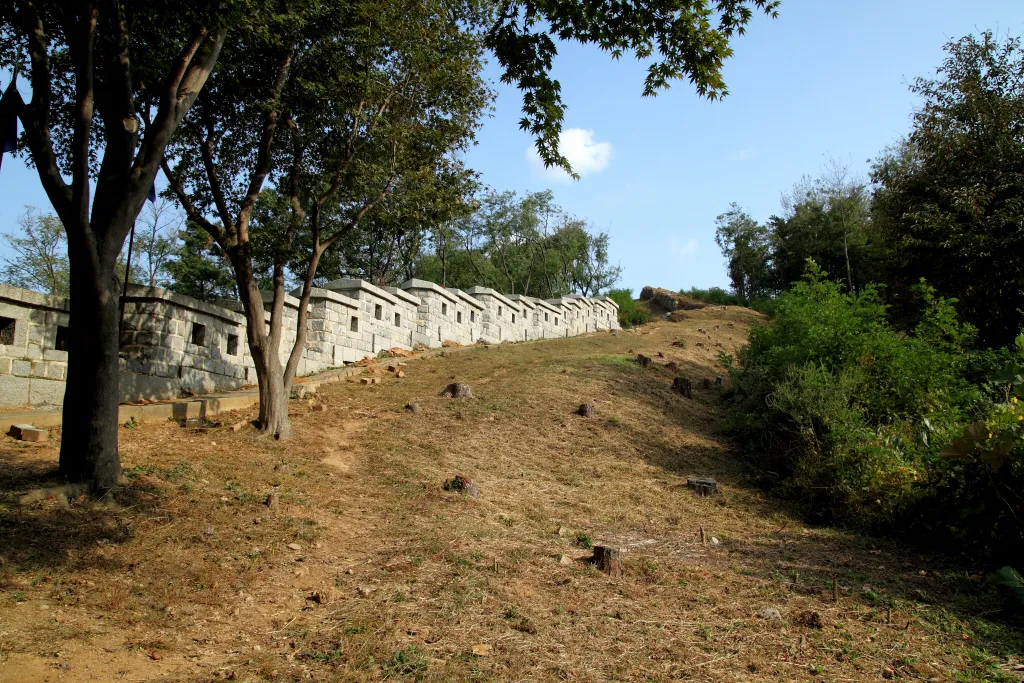
Ganghwasanseong Fortress
江華山城
인천광역시 강화군
Basic information
- Designation
- Historic Site No.132
- Category
- Sites & Pagodas
- Era
- 고려시대
- Designated year
- 1964
- Location
- 강화군, 인천광역시— 인천 강화군 강화읍 국화리 산3번지 일원
- Coordinates
- 37.748158, 126.479998
AI Docent
Coming soonAn AI-generated, friendly retelling of this heritage site is available in Korean. An English version is on our roadmap — for now, please see the official description below.
Description
Built during the Goryeo Dynasty, Ganghwasanseong Fortress circled the Ganghwa area. To move the capital of Goryeo to Ganghwado Island to evade the Mongolian soldiers, Choe I had the palace and fortress built in 1232. Note, however, that the fortress and government office had not been completed. Construction started in full swing in January 1234. It was called Songak since it was built like the palace in Songdo. The fortress consisted of earth making up the inner, middle, and outer ones. Among them, the inner fortress, with circumference of 1,200 meters, is the present Ganghwaseong Fortress. The middle fortress was erected to protect the inner one along the eastern costal area of Ganghwado Island. The outer fortress was the most important defense facility, one that Mongolia could not attack by crossing the sea; it was where the government had supported suppliers for 39 years from the land. When the capital was moved to Gaegyeong in the 11th year of the reign of King Wonjong (1270) of Goryeo, it was demolished based on the treaty of peace with the Mongolians. Note, however, that the downscaled Ganghwaseong Fortress and the inner fortress during the early Joseon Dynasty were reconstructed. Torn down by Qing in 1637 and in the French Invasion in 1866, it was expanded and modified with stone in the third year of the reign of King Sukjong (1677). Anparu (south gate), Jinsongnu (north gate), Cheomhwaru (west gate), Manghannu (east gate), and four Ammun (secret path) and two water gates remain. Command posts and stone walls had been provided as defense facilities, but the stone walls were demolished. Today, the fortress in the eastern part of Ganghwa is missing, but the one at the southern foot of the mountain had been well-preserved. It was a historical site that saw several foreign invasions, including the French Invasion in 1866 and American Expedition in 1871, and treaties of peace following the Japanese Invasion in the late Joseon Dynasty.
Location
지도를 불러오는 중…
Have you visited this place?
Log in and verify your visit on-site via GPS to record a stamp in My Journey. (QR verification coming later.)
Images: KOGL (khs.go.kr) · Data source: Korea Heritage Service Open API (khs.go.kr)