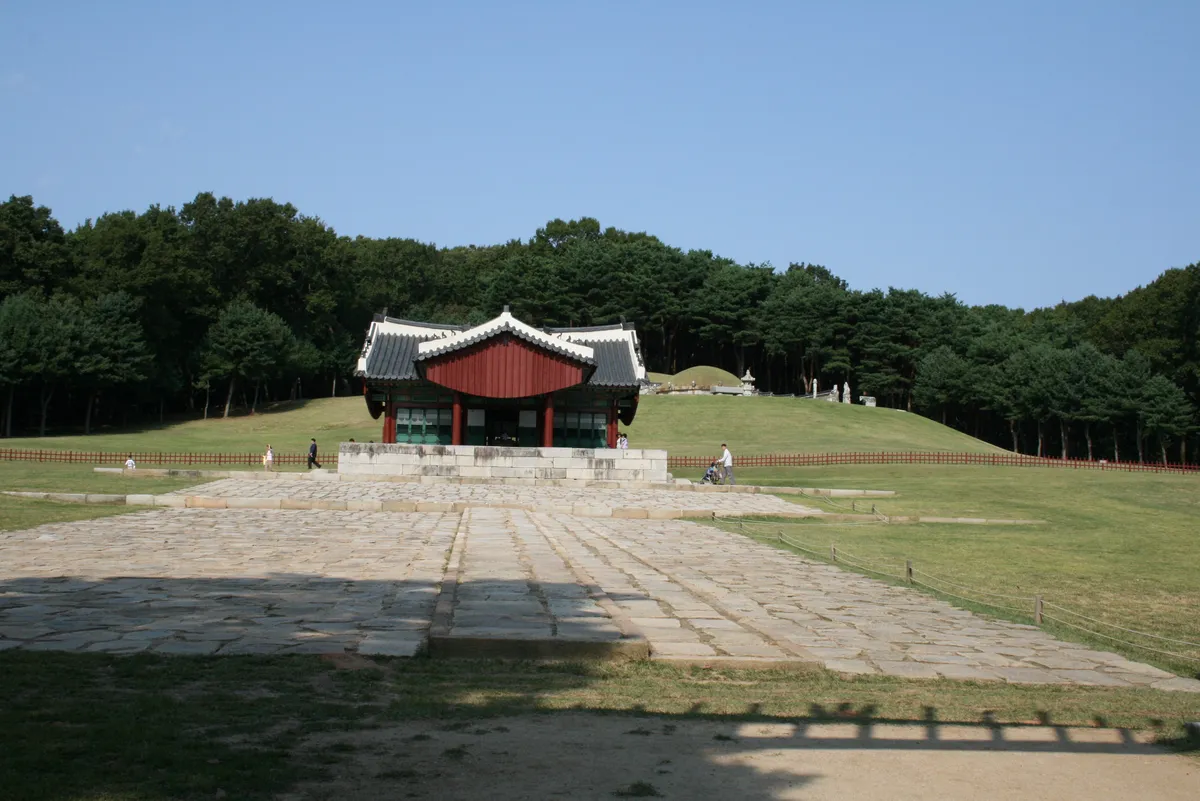
Yungneung and Geolleung Royal Tombs, Hwaseong
華城 隆陵과 健陵
경기도 화성시
Basic information
- Designation
- Historic Site No.206
- Category
- 유적지
- Era
- 조선 정조 13년(1789)
- Designated year
- 1970
- Location
- 화성시, 경기도— 경기 화성시 효행로481번길 21 (안녕동)
- Coordinates
- 37.207975, 126.989093
AI Docent
✨ AI-generatedWelcome to Yungneung and Geolleung Royal Tombs! You're standing in one of Korea's most important burial sites, where two generations of the royal family rest side by side. Yungneung holds Crown Prince Sado and his wife. What makes it special? Look at the stone sculptures—they're remarkably lifelike and uplifting. The civil officer's statue wears a gold crown and became a model for royal tombs for decades afterward. Just nearby is Geolleung, where King Jeongjo and Queen Hyoui lie together. King Jeongjo was the 22nd Joseon king, known for his deep love for his parents and for gathering brilliant scholars. His reign brought a golden age of literature to Korea. Both tombs showcase creative stone lanterns blending old and new Joseon styles. The sculptures of officials and military attendants convey calm dignity and realism. King Jeongjo designed these tombs to be truly original—and they set the standard for royal burials throughout the 19th century. Come explore how stone and earth honor Korea's greatest rulers.
⚠ This is an AI-generated retelling of the official description. For accuracy, refer to the official description below.
Description
Yungneung is the place where Crown Prince Sado and his wife are buried. The prince was named Jangheon when King Jeongjo acceded to the throne and enthroned as Emperor Eui in 1899. Yungneung was named Hyeollyungwon after the park, Yeongwuwon, was moved from Baebongsan Mountain. A stone screen with patterns of peonies and lotus flowers stands alongside the tomb. The stone lantern is constructed using a new style that combines the octagonal style from the early Joseon Dynasty and the rectangular style of the reigns of Kings Sukjong and Yeongjo. The same method was used in Geolleung and Yereung. The stone figure of a person had great influence on later tombs in the nineteenth century. The image itself is very realistic and invigorating as its head, which formerly hung down to the breast, looks upward. There is a civil officer image with a gold crown, which also was influential in subsequent works. King Jeongjo strove to make Hyeollyungwon creative and original. Geolleung is the tomb where King Jeongjo, the 22nd king of Joseon, and his wife Queen Hyoui are buried. King Jeongjo is famous for his filial piety and for his recruitment of wise scholars, and during his reign, led the country to a golden age of literature. The tomb used to stand at the eastern hill of Hyeollyungwon but was moved to the west because the original place was deemed inauspicious after the queen passed away. The graves of the king and the queen were placed together. The tomb forms a ridge with two rooms surrounded by the balustrade. In addition, other sculptures were arranged following the construction of Yungneung. Although there are two graves in the tomb, there is only one stone for the spirit. A stone lantern was constructed combining octagonal and rectangular shapes. The statues of civil and the military vassals set an example for stone sculptures in the royal tombs in evoking a stable and realistic sentiment.
Location
지도를 불러오는 중…
Have you visited this place?
Log in and verify your visit on-site via GPS to record a stamp in My Journey. (QR verification coming later.)
Images: KOGL (khs.go.kr) · Data source: Korea Heritage Service Open API (khs.go.kr)