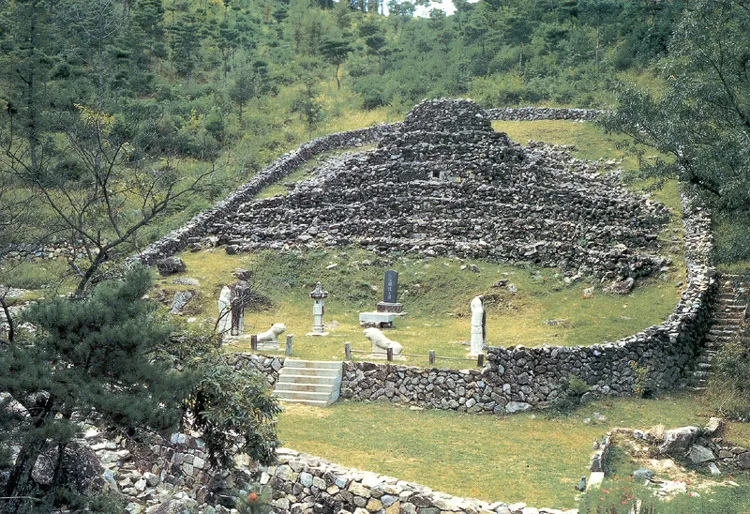
Tomb of King Guhyeong, Sancheong (Presumed)
山淸 傳 仇衡王陵
경상남도 산청군
Basic information
- Designation
- Historic Site No.214
- Category
- 유적지
- Era
- 6세기
- Designated year
- 1971
- Location
- 산청군, 경상남도— 경남 산청군 금서면 화계리 산16번지
- Coordinates
- 35.449333, 127.800374
AI Docent
Coming soonAn AI-generated, friendly retelling of this heritage site is available in Korean. An English version is on our roadmap — for now, please see the official description below.
Description
This is the tomb of the 10th king of the Gaya Kingdom. He was called King Guhyeong, Guhae, or King Yang, who was the grand grandfather of Kim Yu-sin. He became the king of Gaya Confederacy in 521, ruled for 11 years, and surrendered his country to King Beopheung of the Silla Dynasty in 532. There are two different opinions among scholars as to its nature. One is that it must be classified as a pagoda made of stone, and the other that it is the tomb of a king. The reason it may be regarded as a pagoda is that pagodas like this are distributed in the regions of Andong and Uiseong, and the evidence for it being a royal tomb is that notes can be read from books that form a sort of ancient Korean tour guide called Dongguk yeoji seungnam (Augumented Survey of the Geography of Korea) and Saneum-hyeon sancheonjo (Record of Saneum-hyeon): " . . . there is a structure with steps on the four faces, in the form of nine dragons piled up of stones at a distance of about 16 km (40 ri in Korean traditional scale) from the village, so people believe it must be a royal tomb". The earliest historic record citing the name of the tomb can be found in a record of travels called Wangsan simneunggi written by Hong Ui-yeong, a student of Chinese classics in the Joseon Dynasty. According to the book, the name of this tomb is Guhyeong, citing extracts from Wangsansagi (History of Wangsansa Temple) printed by the Wangsansa Temple located to the west of the tomb. The tomb has a unique appearance with steps and shaped layers 7.15m high in the middle of the slope, in contrast with ordinary tombs at that time. The unique characteristics of the tomb are as follows: seven layers at the front and no steps at the back due to being built on a slope, so the overall shape is different from those of pyramids built in level ground.; the top of this tomb is in the shape of an ellipse, rather like an egg; a stone tablet inscribed “Garakguk Yangwangneung” (Tomb of King Yang in Gaya) in the centre of the tomb and stone structures in front of it: these are the more recent features produced beside the original tomb. The royal/monastic palace called Deogyangjeon Hall was built in the 17th year of the reign of King Jeongjo of Joseon for the purpose of preserving remains such as paintings portraying King Guhyeong and his queen, their clothes, and an archery bow, all discovered inside a wooden box in the custody of Wangsansa Temple. What is more, a sacrifice has been offered twice a year spring and fall up to the present day.
Location
지도를 불러오는 중…
Have you visited this place?
Log in and verify your visit on-site via GPS to record a stamp in My Journey. (QR verification coming later.)
Images: KOGL (khs.go.kr) · Data source: Korea Heritage Service Open API (khs.go.kr)