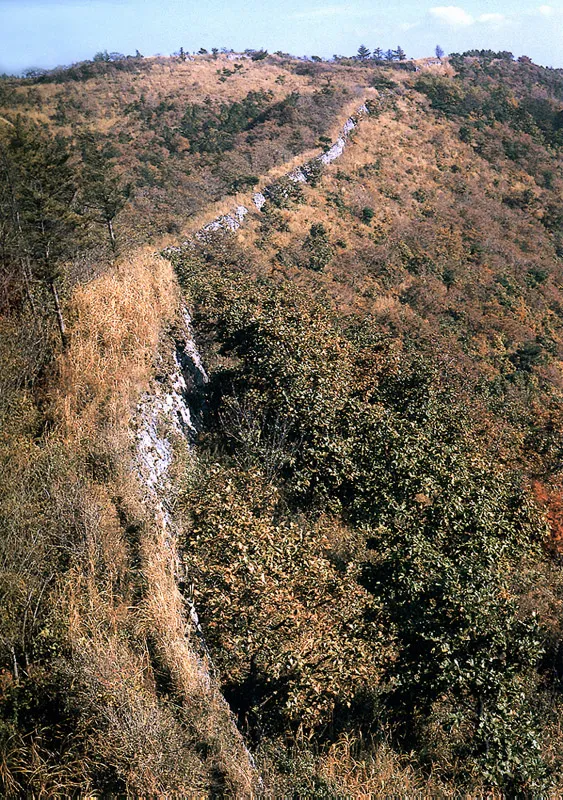
Gasansanseong Fortress, Chilgok
漆谷 架山山城
경상북도 칠곡군
Basic information
- Designation
- Historic Site No.216
- Category
- Sites & Pagodas
- Era
- 조선시대
- Designated year
- 1971
- Location
- 칠곡군, 경상북도— 경북 칠곡군 가산면 가산리 산98-1번지
- Coordinates
- 36.019401, 128.589423
AI Docent
Coming soonAn AI-generated, friendly retelling of this heritage site is available in Korean. An English version is on our roadmap — for now, please see the official description below.
Description
This fortress was constructed for the purpose of national defense against foreign attacks following two consecutive wars, the Japanese invasion of Korea in 1592 and the Manchu invasion in 1636. The fortress has the triple structure with fortifications on the inside, the outside, and in the middle. It took so long to finish the construction of the whole structures, because each layer of the three walls was built one by one, not at the same time. Joseon kings always appointed a military officer to the office of governor-general responsible for this region in order to maintain absolute security. They exercised control over all army communications, supplies including military materiel and rice, and military camps in the districts of Hayang, Sillyeong, Uiheung, Uiseong, and Gunwi, as well as a corps called Chilgok Dohobu, a force that was stationed in this fortress. The interior fortress was built at the proposal of Yi Myeong-ung, a provincial governor called Gwanchalsa, to King Injo in the 18th year of his reign (1640), a time when the special force Chilgok Dohobu was already stationed there. The middle one was put up at King Yeongjo's indication to a provincial governor, Jeong Ik-ha, in 1741, the 17th year of his reign to defend the area effectively against any enemy attacks. There were warehouses of the four villages in the middle fortress to take charge of emergency rice especially for effective supply at a time of crisis. The exterior walls were erected by order of King Sukjong in 1700, the 26th year of his reign. The entrance to the fortress is the south gate of the exterior wall. There are lots of Buddhist temple sites around the fortress including Songnimsa, established in the Silla Period. Torrential rain in 1960 caused damage to Hongyemun Arch at the top, and a portion of the wall disappeared, but apart from that, the entirely original appearance is very well maintained. This fortress is regarded as a representative example showing the mode and technology of fortifications in the late Joseon Dynasty, mainly utilizing the natural configuration of the land and its topography.
Location
지도를 불러오는 중…
Have you visited this place?
Log in and verify your visit on-site via GPS to record a stamp in My Journey. (QR verification coming later.)
Images: KOGL (khs.go.kr) · Data source: Korea Heritage Service Open API (khs.go.kr)