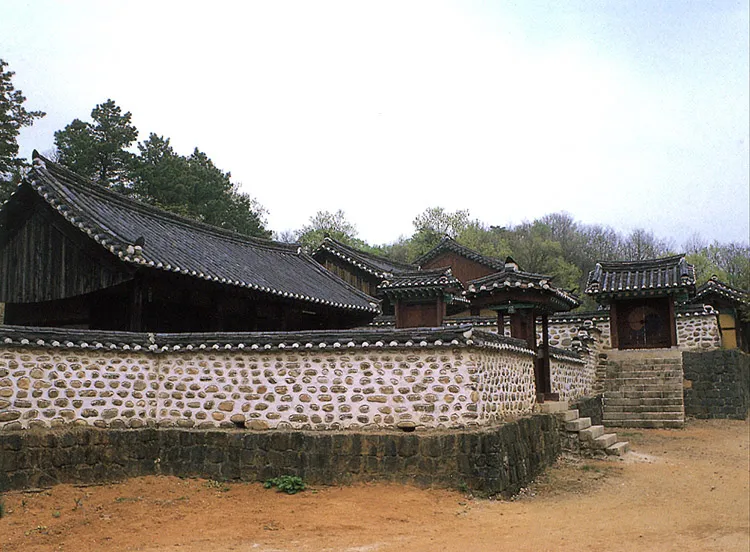
Sunguijeon Shrine Site, Yeoncheon
漣川 崇義殿址
경기도 연천군
Basic information
- Designation
- Historic Site No.223
- Category
- Architecture
- Era
- 조선 태조 6년(1397)
- Designated year
- 1971
- Location
- 연천군, 경기도— 경기 연천군 미산면 숭의전로 382-27 (아미리)
- Coordinates
- 38.023608, 126.973206
AI Docent
Coming soonAn AI-generated, friendly retelling of this heritage site is available in Korean. An English version is on our roadmap — for now, please see the official description below.
Description
This is the site of Sunguijeon Shrine, which during the period of the Joseon Dynasty was a place for sacrifice to eight of the kings of the Goryeo Dynasty including King Taejo, and for honoring their mortuary memorial tablets. Yi Seong-gye, the founder of the Joseon Dynasty, built Sunguijeon to enshrine King Taejo in 1397, and King Jeongjong performed religious services to seven other kings of Goryeo: Hyejong, Seongjong, Hyeonjong, Munjong, Wonjong, Chungnyeol, and Gongmin, from the first year of his reign (1399). The shrine was repaired in the reigns of King Sejong the Great (the 5th year of his reign, 1423) and King Munjong (the 2nd year of his reign, 1452). In Munjong’s reign, it was renamed Sunguijeon Shrine to hold ceremonies where the mortuary memorial tablets of the four great kings of Goryeo, Taejo, Hyeonjong, Munjong and Wonjong were honored, and religious services were performed for them and also for fifteen loyal courtiers in the Goryeo Dynasty. Descendants of the Goryeo Dynasty were charged with the task of overall management and administration of the shrine. In fact, this was a political obligation enforced by the Joseon Dynasty to neutralize dissatisfaction on the part of members of royal family and drifting people who were oriented to the former dynasty. In the Japanese colonial period, the shrine was managed by the Government-General of Joseon but was destroyed, and disappeared during the Korean War (1950~1953). Sunguijeon can be seen as a place of fidelity to the Goryeo Dynasty as well as affection for its past glory on the part of the former royal family and wandering people - the surname of the Goryeo royal family is Wang, which also means “king”.
Location
지도를 불러오는 중…
Have you visited this place?
Log in and verify your visit on-site via GPS to record a stamp in My Journey. (QR verification coming later.)
Images: KOGL (khs.go.kr) · Data source: Korea Heritage Service Open API (khs.go.kr)