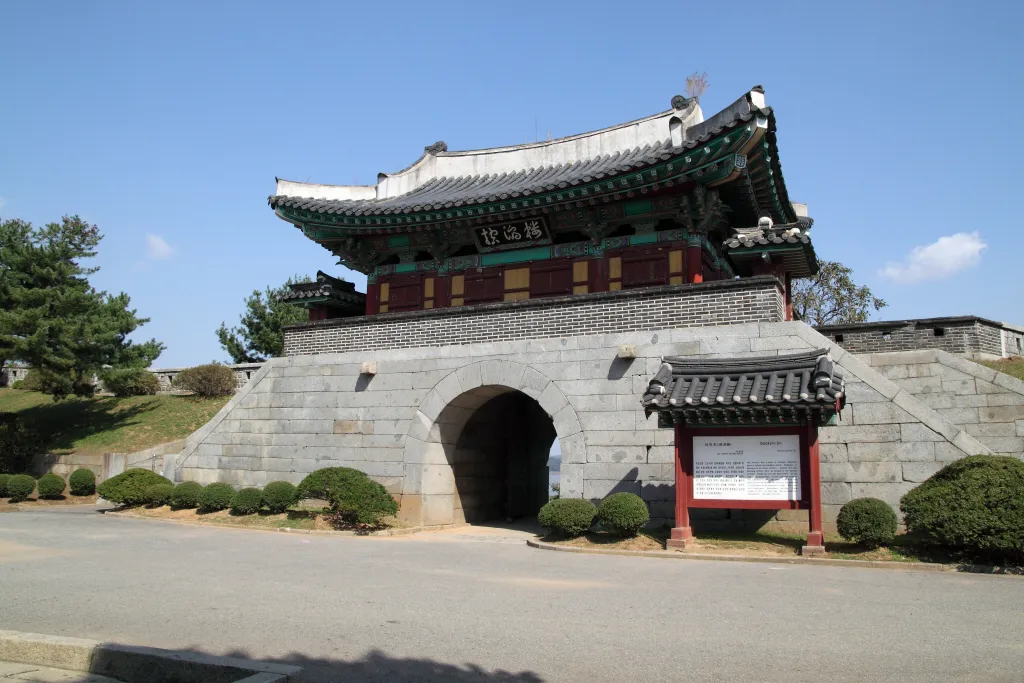
Deokjinjin Fort, Ganghwa
江華 德津鎭
인천광역시 강화군
Basic information
- Designation
- Historic Site No.226
- Category
- Sites & Pagodas
- Era
- 조선시대
- Designated year
- 1971
- Location
- 강화군, 인천광역시— 인천 강화군 불은면 덕성리 373번지
- Coordinates
- 37.649317, 126.524394
AI Docent
Coming soonAn AI-generated, friendly retelling of this heritage site is available in Korean. An English version is on our roadmap — for now, please see the official description below.
Description
This was a military camp that held a strategic position at the outer line of defense of the Ganghwa Strait in the Goryeo Dynasty. It was a camp for infantry and artillery, and one of twelve such camps, with an inner and outer wall, a fortification and a defensive position specially constructed in order to defend Ganghwa Island after the end of the war with the Qing Dynasty. Deokjinjin Fort was originally established as a naval station. In 1666, the 7th year of the reign of King Hyojong, it was moved to Deokpo region to strengthen national defense. By 1679, the 5th year of King Sukjong’s reign, its defenders were recognized as a crack contingent, with two units of artillery stationed at Deokjin and Namjang, and two guard posts stationed at Yongdu and Deokjin. This camp, one of twelve established in Ganghwa defended the island’s most important strategic position. At the time of the French invasion of Ganghwa in 1866, a corps led by an army general, Yang Heon-su, defeated a French army by exploiting the configuration of the land around Jeongjoksanseong Fortress and Deokjinjin Fort. The corps fought a hard battle against bombardment by a U.S. fleet, but the fort was occupied by U.S. troops who had landed at Chojijin Fort. During the battle, low fences erected to provide cover for the Korean forces were demolished. In 1976 the fortress walls and the fortifications were repaired, artillery positions in Namjang were restored, a gatehouse at with an upper story was rebuilt with 3 rooms at the front and 2 rooms at the side, and cannons were returned to their original positions.
Location
지도를 불러오는 중…
Have you visited this place?
Log in and verify your visit on-site via GPS to record a stamp in My Journey. (QR verification coming later.)
Images: KOGL (khs.go.kr) · Data source: Korea Heritage Service Open API (khs.go.kr)