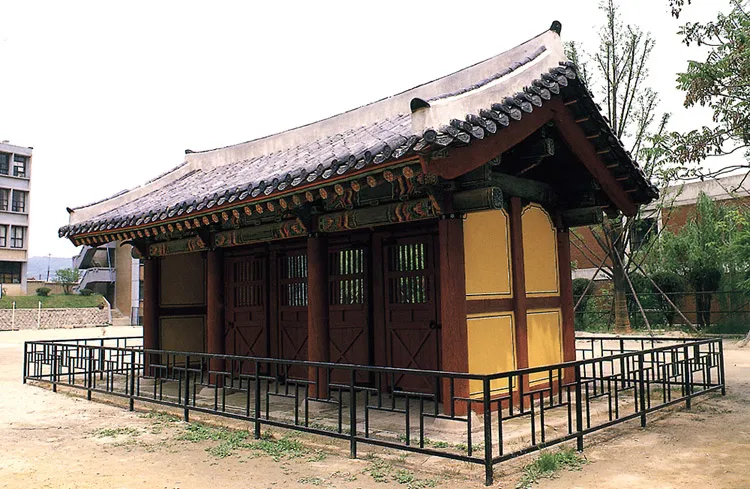
Gyeongmogung Shrine Site, Seoul
서울 景慕宮址
서울특별시 종로구
Basic information
- Designation
- Historic Site No.237
- Category
- Architecture
- Era
- 조선시대
- Designated year
- 1973
- Location
- 종로구, 서울특별시— 서울 종로구 연건동 28-2번지
- Coordinates
- 37.580475, 126.999624
AI Docent
Coming soonAn AI-generated, friendly retelling of this heritage site is available in Korean. An English version is on our roadmap — for now, please see the official description below.
Description
At first, the site where Gyeongmogung was located had been called Hamchunwon Garden. Hamchunwon is one of the gardens founded in the age of the Joseon Dynasty, and is at present located in the grounds of Seoul National University Hospital. According to Dongguk yeojibigo (Reference on the Geography of Korea), gardens of the east of Changgyeonggung Palace, and at the south of Gaeyangmun Gate of Gyeonghuigung Palace were named Hamchunwon, but the most typical one in view of its location and scale, was that at the east of Changgyeonggung Palace. Hamchunwon originated in the 15th year of the reign of King Seongjong of the Joseon Dynasty (1484), when Changgyeonggung Palace was built. Trees were planted, and a fence put in place in accordance with the theory of feng shui, and people who had nothing to do with the palace were forbidden to enter. Later, in the 24th year of the reign of King Seongjong (1493), it was given its official name, and attached to Changgyeonggung Palace. In the reign of King Yeonsangun the garden was expanded by driving out private houses. A large gate was built and a military force stationed to control access. Later, King Jungjong allowed people to live there once again. During the Japanese invasion of Korea in 1592 the maintenance of the garden was overlooked to allow the temporary burial of Crown Princess Deokbin. Later, in the reign of King Injo (1623–1649), half of its area was shared by Taeboksa (The Royal Stable Administration), and the garden was used for grazing horses for the next 140 years. In the 40th year of King Yeongjo’s reign (1764) a shrine built for Prince Sado was moved here, called Gyeongmogung Shrine when King Jeongjo succeeded the throne. It was renovated extensively in the 9th year of his reign (1785). But Gyeongmogung came to losing its function as a shrine when the Jangjo, the tablet of Prince Sado, was moved to Jongmyo Shrine in the 3rd year of King Gwangmu’s reign (1899), and its name was accordingly changed to Gyeongmojeon Hall. In the 4th year of Gwangmu’s reign Yeonghuijeon Hall, which housed the portraits of six kings, Taejo, Sejo, Seongjong, Sukjong, Yeongjo, and Sunjo, was moved to this site and rebuilt. Later Gyeongseong Imperial University was built in the palace area, as a result of which the palace lost its original features, a process completed by the burning down of the old buildings during the Korean War. Hamchunwon was one of the splendid creations of the latter years of the Joseon Dynasty, but the only part of its heritage remaining is the Hamchunmun Gate.
Location
지도를 불러오는 중…
Have you visited this place?
Log in and verify your visit on-site via GPS to record a stamp in My Journey. (QR verification coming later.)
Images: KOGL (khs.go.kr) · Data source: Korea Heritage Service Open API (khs.go.kr)