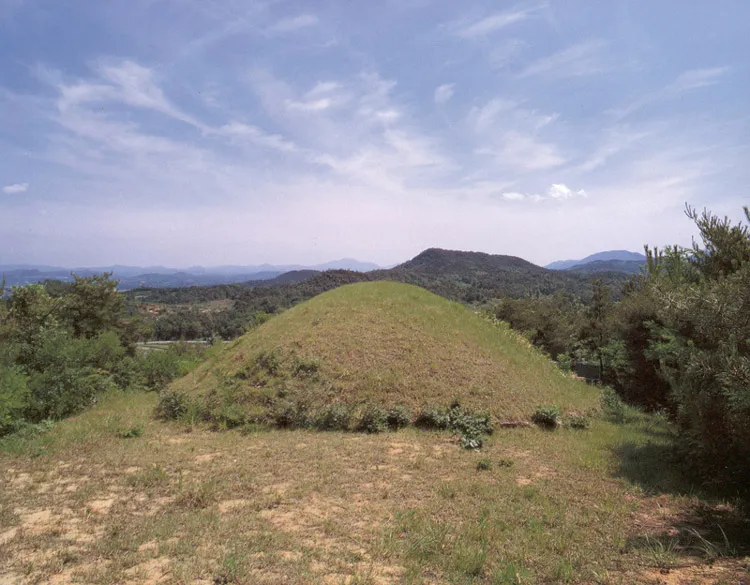
Tomb of Eo Suk in Sunheung, Yeongju
榮州 順興 於宿墓
경상북도 영주시
Basic information
- Designation
- Historic Site No.238
- Category
- 유적지
- Era
- 신라시대
- Designated year
- 1974
- Location
- 영주시, 경상북도— 경북 영주시 순흥면 태장리 산95번지
- Coordinates
- 36.917254, 128.561780
AI Docent
Coming soonAn AI-generated, friendly retelling of this heritage site is available in Korean. An English version is on our roadmap — for now, please see the official description below.
Description
Located in Namsa-myeon, southwest of Bibongsan Mountain, this mural tomb built in the age of the Silla Dynasty was investigated by the Ewha Womans University Museum in 1971. It is a round tomb built of clay with a diameter of 16 meters. Due to the damage, It is not possible to measure the original height. The foot of the tomb was surrounded by stones for protection. It is a stone chamber tomb, with a loculus housing the dead and a channel leading to outside. Inside the loculus the four sidewalls and the ceiling were painted with pictures after coating the surface with lime, and there is a broad stand installed on the floor on which to place the coffin. Because of robbery there are no relics remaining, and clay was piled up on the western wall. The loculus was closed by a stone plate raised like a door cover, and rough stones were piled up at the entrance of the channel to close the tomb. There were pictures painted all over the interior of the tomb, but most are damaged except the ones on the ceiling of the channel and the stone closure, which were painted after the surface was coated with lime. On the ceiling was painted a large lotus design all in red, which is thought to be unique. On the outside of the stone closure there is a picture thought to be a human image, but it is very hard to recognize. On the inside 8 characters reading "Eulmyonyeon Eosukjisulgan" were engraved. Eulmyonyeon is believed to refer to the 17th year of the reign of King Jinpyeong of the Silla Dynasty (595 A.D.) in the final years of the 6th century after Buddhism had been officially approved by King Beopheung of Silla, and given the name, Eo Suk, he was probably from the Goguryeo Kingdom; ji means “to speak up”, and sulgan was the title of a government officer in Silla. All this makes it possible to suppose that here might have been the border between Goguryeo and Silla at that time, though the tomb was already damaged a long time ago and only fragments of relics were found. It became very important historical material from the viewpoint that it was found in Silla territory together with the mural tomb in Sunheung, and it is the only one which was named after who was buried. At the same time, since the lotus design and the person named Eo Suk are believed to have come from Goguryeo, it is also a valuable evidence indicating the possibility that this area could have been a channel between Goguryeo and Silla,.
Location
지도를 불러오는 중…
Have you visited this place?
Log in and verify your visit on-site via GPS to record a stamp in My Journey. (QR verification coming later.)
Images: KOGL (khs.go.kr) · Data source: Korea Heritage Service Open API (khs.go.kr)