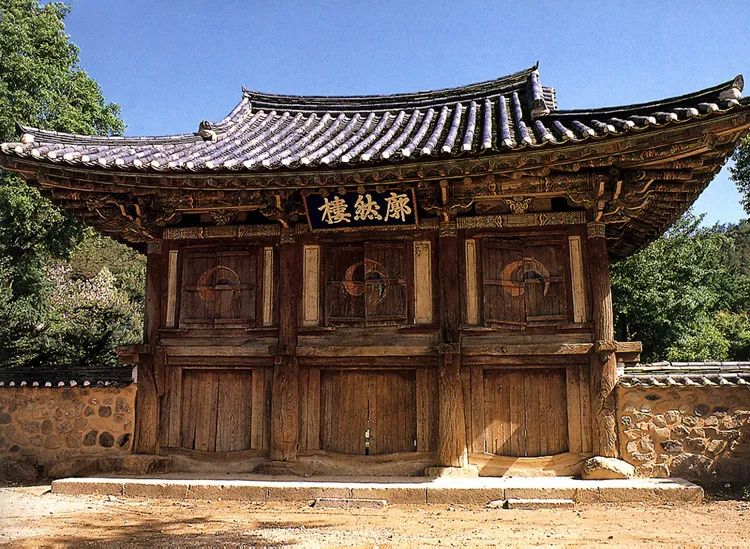
Piram Seowon Confucian Academy, Jangseong
長城 筆巖書院
전라남도 장성군
Basic information
- Designation
- Historic Site No.242
- Category
- Architecture
- Era
- 조선 선조 23년(1590년)
- Designated year
- 1975
- Location
- 장성군, 전라남도— 전라남도 장성군 필암서원로 184(황룡면)
- Coordinates
- 35.310663, 126.751667
AI Docent
✨ AI-generatedWelcome to Piram Seowon, a beautiful Confucian academy nestled in Jangseong! Imagine stepping back to 1590, when this place was built to honor the scholar Kim In-hu. For centuries, scholars gathered here to study Confucianism and perform sacred rituals—a life devoted to learning and tradition. The academy's layout tells its own story. You'll notice how buildings are arranged with study rooms at the front and ritual spaces at the back, following traditional principles. The elegant Cheongjeoldang Lecture Hall is where classes happened, while students lived in nearby quarters. Behind everything stands a sacred shrine, set apart by walls and gates. What makes Piram truly special? In the shrine's eastern building, Gyeongjanggak, precious books and documents from the 18th and 20th centuries are preserved. These materials offer rare glimpses into how Confucian scholars lived and thought. This academy survived fire and invasion, rebuilt and renamed by a king himself in 1662. Today, it stands as a testament to Korea's scholarly heritage—a place where you can feel the weight of centuries of learning.
⚠ This is an AI-generated retelling of the official description. For accuracy, refer to the official description below.
Description
In this place, scholars used to assemble to study Confucianism and perform sacrificial rites. It was built in Gisan-ri, the hometown of Kim In-hu (1510-1560), in commemoration of him in the 23rd year of the reign of King Seonjo (1590). It was burnt down during the Japanese invasion of Korea in 1597, and reconstructed in the 24th year of the reign of King Injo (1624). King Hyeonjong, on his third reigning year (1662), personally bestowed the name plate 'Piramseowon' on this place. It was in 1627 that it moved to the present location. The inside of the academy is arranged according to the rule of jeonhakhumyo, which means that the room for study is situated at the front of the house while the room for sacrificial rites is located at the back. The academy is divided into many parts according to their use. Hwagyeonnu Pavilion is the resting place and Cheongjeoldang Lecture Hall was where classes took place. Behind Hwagyeonnu Pavilion and Cheongjeoldang, there are the Dongjae and Seojae, the living quarters of the students. To the north of the Dongjae and Seojae, there is a shrine, separated from the rest of the world by its gate and walls, where sacrificial rites were performed. Under the eaves of Cheongjeoldang, there hangs the name plate 'Piramseowon’ written by Yun Bong-gu. The name plate for Hwagyeonnu Pavilion was written by Song Si-yeol. To the east of the shrine is Gyeongjanggak where books and written documents classified by the government as treasures are stored and preserved. Gyeongjanggak contains materials that were introduced between the 18th century and the beginning of the 20th century. These materials are highly valued in the study of the local educational system of Confucianism and the social and economic lives of Confucian scholars.
Location
지도를 불러오는 중…
Have you visited this place?
Log in and verify your visit on-site via GPS to record a stamp in My Journey. (QR verification coming later.)
Images: KOGL (khs.go.kr) · Data source: Korea Heritage Service Open API (khs.go.kr)