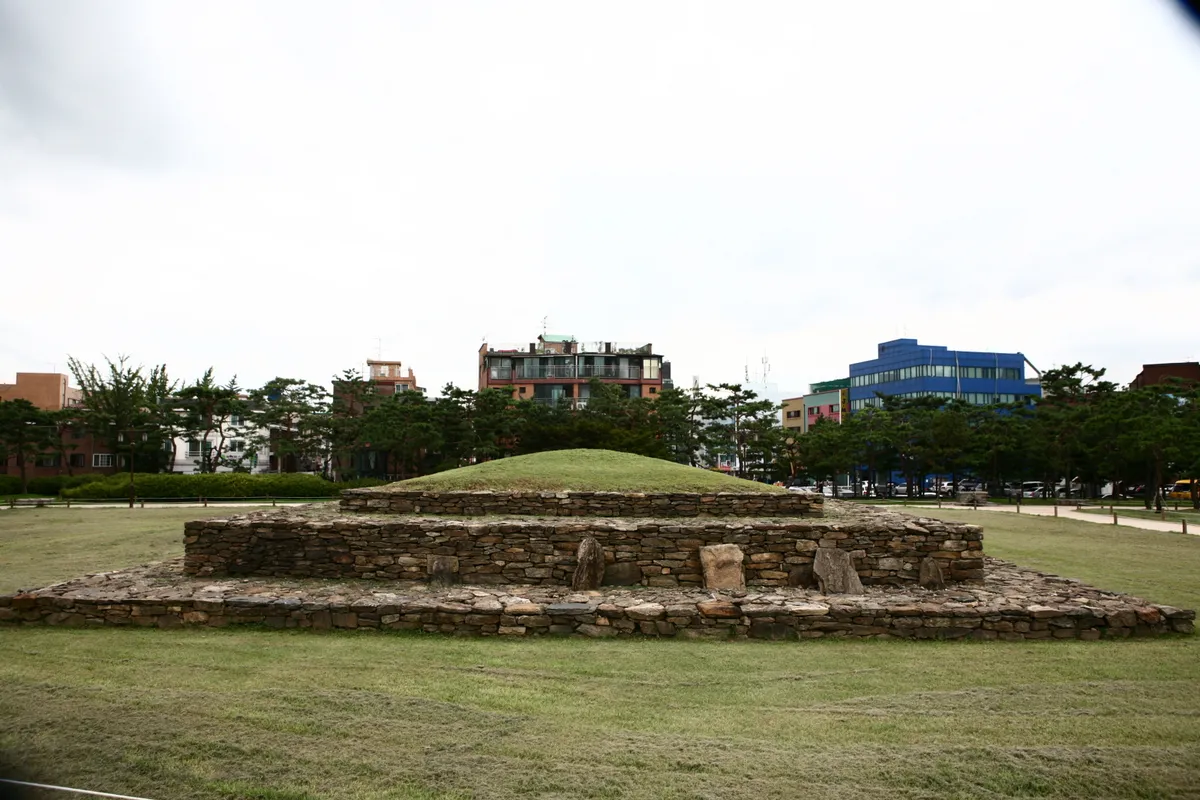
Ancient Tombs in Seokchon-dong, Seoul
서울 石村洞 古墳群
서울특별시 송파구
Basic information
- Designation
- Historic Site No.243
- Category
- 유적지
- Era
- 백제시대 초기
- Designated year
- 1975
- Location
- 송파구, 서울특별시— 서울 송파구 석촌동 61-6번지
- Coordinates
- 37.502534, 127.102249
AI Docent
Coming soonAn AI-generated, friendly retelling of this heritage site is available in Korean. An English version is on our roadmap — for now, please see the official description below.
Description
The traditional Goguryeo tomb called Jeokseokchong (stone mound tomb) first appeared in the early days of Goguryeo. To make this kind of tomb, flat square stones are firstly laid down on the ground. Then a wooden coffin is placed on top of the stones, and finally the coffin is once again covered up with stones. The ancient tombs of Seokchon-dong come down from the early years of Baekje. They were first investigated during the Japanese occupation. At the time of their discovery the plot of ground where the two tombs, tomb no. 1 and no. 2, stood was used by local inhabitants as farming land, so it was not possible to discern with certainty what were the inner structures and relics of the tomb. Tomb no. 3 is a stepped stone mound tomb. This form made its first appearance around the transitional period between B.C. and A.D. To make it, a quite high piece of ground is leveled down, and the edges are framed around with big, long stones. The stones are heaped up in such a way that the tomb is storied, or layered. Tomb no. 3 is a three-story tomb. It is acknowledged to be larger than Janggunchong (Tomb of the General), located in Tonggu, Manchuria, the territory of ancient Goguryeo and present-day China. Due to incomplete investigation, the inner structure of tomb no. 5 and its relics remain obscure to a certain degree. However, it appears to have been a family burial place. Stones with similar composition to those used to build the tomb can be found around the burial ground. Tomb no. 5 is a two-story tomb made with large stones. Nothing certain is known about the interior, but it is possible to infer that these were family tombs of the local governing class. Their social status seems to be below that of the people buried in large tombs nearby, and above that of the people buried in the jar coffin tomb, or small stone chamber tomb. Along with the tombs in Garak-dong and Bangi-dong, these tombs disclose something of the culture and history of early Baekje, and so are highly valued.
Location
지도를 불러오는 중…
Have you visited this place?
Log in and verify your visit on-site via GPS to record a stamp in My Journey. (QR verification coming later.)
Images: KOGL (khs.go.kr) · Data source: Korea Heritage Service Open API (khs.go.kr)