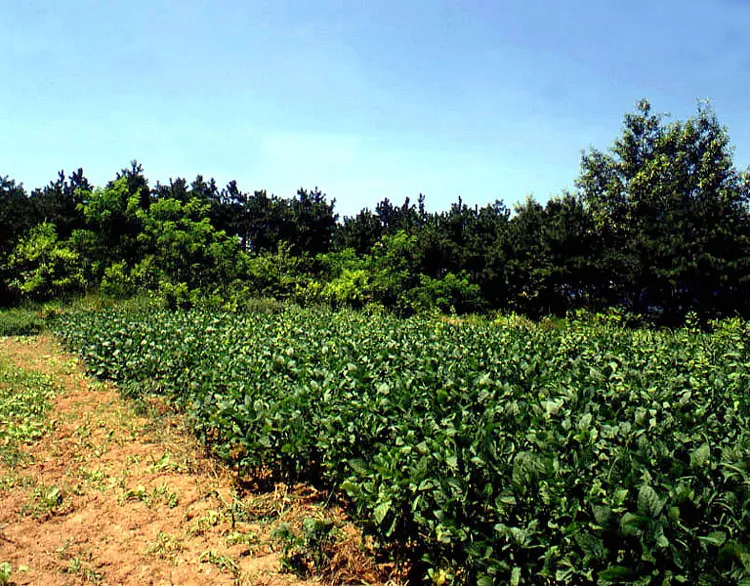
Archaeological Site in Songguk-ri, Buyeo
扶餘 松菊里 遺蹟
충청남도 부여군
Basic information
- Designation
- Historic Site No.249
- Category
- Architecture
- Era
- 선사시대
- Designated year
- 1976
- Location
- 부여군, 충청남도— 충남 부여군 초촌면 송국리 산24-1번지
- Coordinates
- 36.260745, 127.031357
AI Docent
Coming soonAn AI-generated, friendly retelling of this heritage site is available in Korean. An English version is on our roadmap — for now, please see the official description below.
Description
This is an underground pit habitation from the Bronze Age located in Songguk-ri, Buyeo-gun, Chungcheongnam-do. It is supposed that there are about 100 houses on the low downhills near the streams and fields. The habitations are of two kinds distinguished by their shape, circular or rectangular. The circular sites are dug up 30-150cm deep in the ground, with a wall dug shallowly for entrance. Signs of fireplaces have not been found, but there are multiple holes for storage. In the center there is a long elliptical hole about 1m long and inside this are several more circular holes. The rectangular sites had two types, one is dug up 30cm deep, and the other is more like on the ground. As for the latter, it looks like it had no hole to bolster pillars but there were foundation stones, which appear in later houses with more developed architecture. Inside the habitation many kinds of earthenware and stone tools were discovered. Including the ones with no pattern, there were burnished red pottery and black pottery. Pattern-less vessels have a flat bottom and a long egg-shaped body. There is no neck and the beak is bent a little to the outside. They are distinct from former pieces with no pattern, thus, are called Songguk-ri styled pottery. Various stone tools include knives, arrowheads, parts of spinning wheels and axes. In addition, as much as 395g of burnt rice was excavated, and also coal sleets and molds for casting bronze axes, which can be found nowhere else in South Korea. These were similar to the type of molds found in Liaoning province. This discovery shows that Liaoning-styled bronze axes were also made in the southern part of the Korean peninsula. It has been ascertained that to the west of the habitations, there is a primitive form of kiln site for making pattern-less potteries, the oldest in Korea. It is believed on the basis of the excavated relics that the habitations at Songguk-ri were made by people who lived on farming and hunting around the 7-6th century B.C. The fact that the evidence places those people in the era of plain coarse pottery, and that graves were discovered along with the habitations at Songguk-ri reveals that people lived in communities. It also makes it possible to ascertain the range of culture based on a new form of housing and a new form of pottery. The discovery of burnt rice here helps to explain the origin and expansion of rice crops in the Korean peninsula. Generally, the Songguk-ri habitations are an important historic site in for attempts to reconstruct the lives of ancient days.
Location
지도를 불러오는 중…
Have you visited this place?
Log in and verify your visit on-site via GPS to record a stamp in My Journey. (QR verification coming later.)
Images: KOGL (khs.go.kr) · Data source: Korea Heritage Service Open API (khs.go.kr)