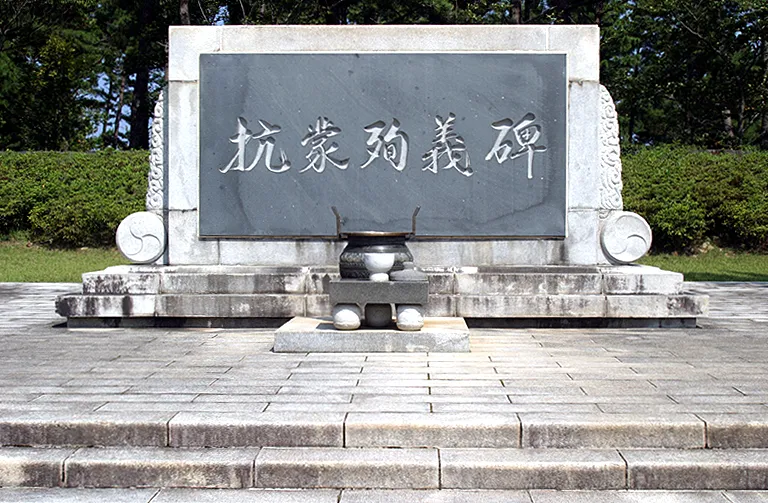
Historic Site of Anti-Mongolian Struggle in Hangpadu-ri, Jeju
濟州 缸坡頭里 抗蒙 遺蹟
제주특별자치도 제주시
Basic information
- Designation
- Historic Site No.396
- Category
- Sites & Pagodas
- Era
- 1271년
- Designated year
- 1997
- Location
- 제주시, 제주특별자치도— 제주 제주시 애월읍 고성리 1126-1번지 외
- Coordinates
- 33.452280, 126.409011
AI Docent
Coming soonAn AI-generated, friendly retelling of this heritage site is available in Korean. An English version is on our roadmap — for now, please see the official description below.
Description
This is the place where Sambyeolcho, the military units led by General Kim Tong-jeong, fought for the last time against the unified troops of Goryeo and Yuan in 1273, the 14th year of the reign of King Wonjong of the Goryeo Dynasty. Sambyeolcho refers to the special forces responsible for maintaining social order and battling against foreign invasions during the Goryeo Dynasty. It figured in some of the fiercest battles against the invading troops during the war against Yuan China. After being defeated in the battle of Jindo Island, Sambyeolcho moved to Jeju-do in 1271, the 12th year of the reign of King Wonjong. The soldiers of Sambyeolcho built the double-walled fortress, constructing the vertically erected stonewall inside and the mud wall outside along the hills and valleys. These walls were about 190 - 215 m tall. Goseongcheon Stream on the east and Sowangcheon Stream on the west protected these walls. The overall terrain around the walls is very ideal for building a fortress -- the south is high, the north is low, the east is flat, and the west has a stream centering on the fortress. The fortress was surrounded by farming field, meadow, and rice paddies. The remains of the mud wall have been preserved in part. Many other vestiges have also been found in the fortress, such as stone shot by an arrow, tiles, small pond, and hinges. As a result of efforts to refurbish and preserve the site, a memorial arch and a tower have been built, with documentary pictures of Sambyeolcho's battles against Yuan China painted. This place has been well-preserved and is used as an educational spot for students.
Location
지도를 불러오는 중…
Have you visited this place?
Log in and verify your visit on-site via GPS to record a stamp in My Journey. (QR verification coming later.)
Images: KOGL (khs.go.kr) · Data source: Korea Heritage Service Open API (khs.go.kr)