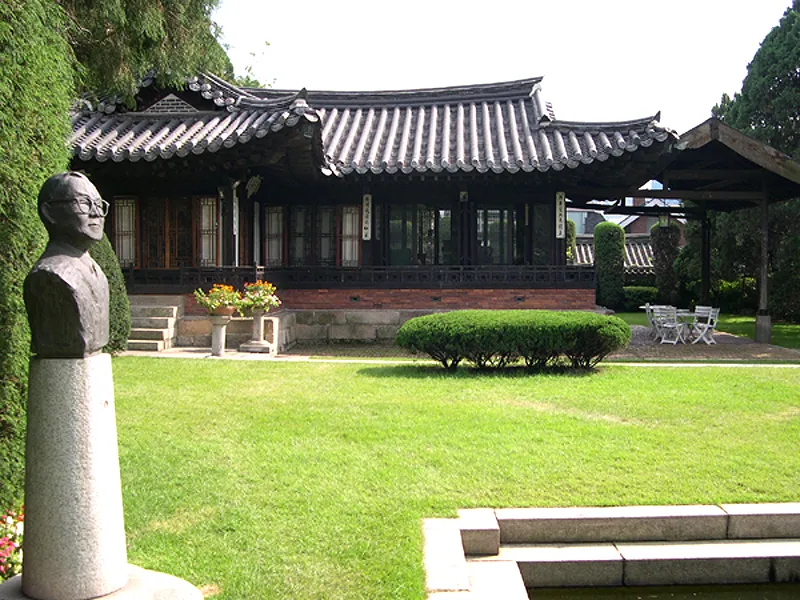
Yun Po-sun's House in Anguk-dong
安國洞 尹潽善家
서울특별시 종로구
Basic information
- Designation
- Historic Site No.438
- Category
- Architecture
- Era
- 조선 고종
- Designated year
- 2002
- Location
- 종로구, 서울특별시— 서울 종로구 안국동 8-1번지 외
- Coordinates
- 37.578845, 126.983671
AI Docent
Coming soonAn AI-generated, friendly retelling of this heritage site is available in Korean. An English version is on our roadmap — for now, please see the official description below.
Description
As the home of former Korean president Yun Po-sun, this house was built in 1870 (7th year of the reign of King Gojong) and purchased by Yun’s father, Chisogong, around 1910. Yun’s family moved into the house when Yun was 7-8 years old. Even while holding the post of president, Yun administered state affairs from this house rather than Cheongwadae, the presidential office. Independence fighter Bak Yeong-hyo stayed briefly in this house after returning to Korea from Japan in 1910. An upper-class Korean home, the house sits on a relatively wide lot and consists of outer and inner sarangchae (men's quarters), anchae (women’s quarters), front gate, servants’ quarters, storerooms, and other facilities. From the outside, each part of the house appears to take the form of a traditional tile-roof Korean house, but the details are executed in the manner of the late Ching of China. Yun applied the Chinese style, which he had seen while serving on the Shanghai Provisional Government; thus making the house unique for its time. The interior decoration and furniture were basically Western style for the sake of convenience in everyday life but had traditional elements mixed in as well. The separate buildings bear signs written by the king and famous people. The hanging board on the outer sarangchae is believed to have been written by King Sunjo, with another hanging board reading “jinchungboguk” and which was written by Kim Ok-gyun. In the yard behind the men’s quarters are a pond and some plum and Chinese juniper trees. The landscaping is not traditionally Korean but shows an aspect of modern landscaping, which emerged in the late 19th century. This house is also significant in Korea’s political history as the birthplace of Korea’s first Democratic Party and was used as the opposing party’s office and conference rooms from the 1950s to the 1970s. It also functioned as the headquarters for the democracy movement and as refuge for political activists. As the home of an aristocrat built 140 years ago in the traditional way with wood and tile roof but with details and furniture designed for greater convenience, the house of Yun Po-sun shows the dignity of a ruling family at the end of the Korean Empire Period, at the same time revealing the changes in architecture and housing at that time. For these reasons, the house has great value in the history of Korean architecture. As the cradle of Korea’s first Democratic Party, it also has an important place in the country’s political history.
Location
지도를 불러오는 중…
Have you visited this place?
Log in and verify your visit on-site via GPS to record a stamp in My Journey. (QR verification coming later.)
Images: KOGL (khs.go.kr) · Data source: Korea Heritage Service Open API (khs.go.kr)