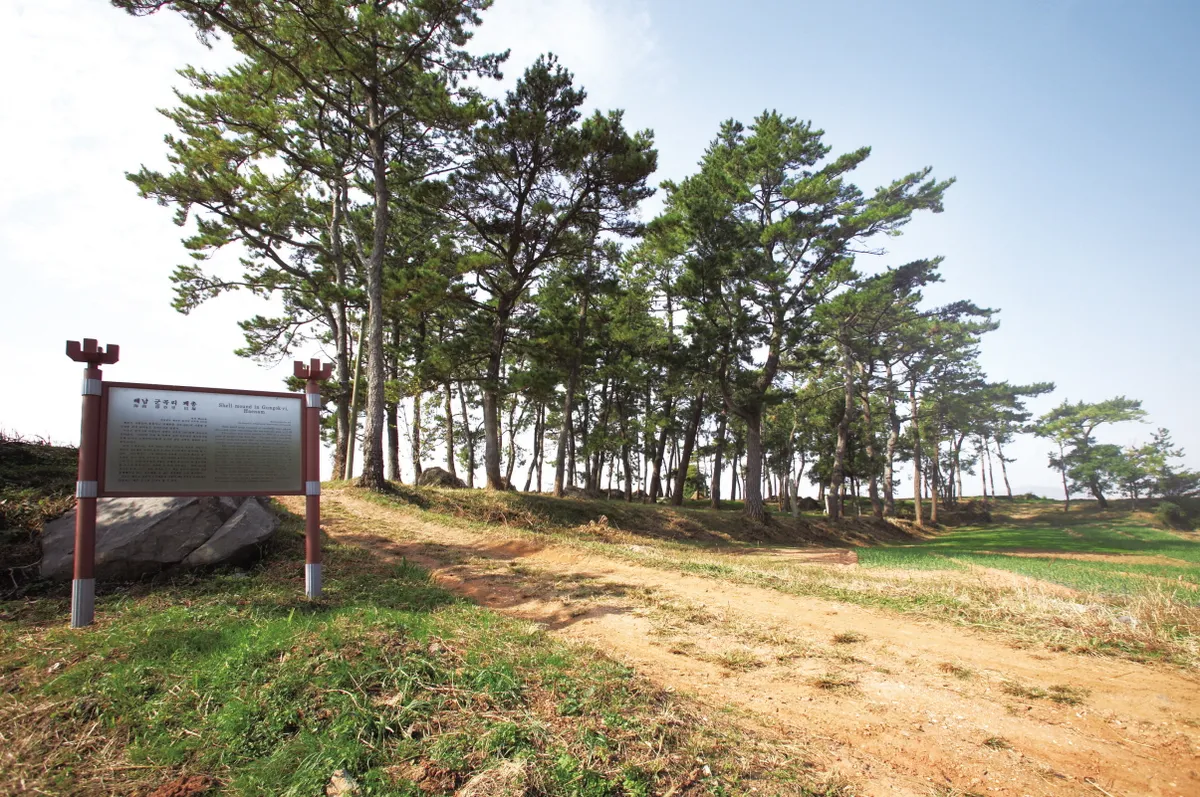
Shell Mound in Gungok-ri, Haenam
海南 郡谷里 貝塚
전라남도 해남군
Basic information
- Designation
- Historic Site No.449
- Category
- 유적지
- Designated year
- 2003
- Location
- 해남군, 전라남도— 전남 해남군 송지면 군곡리
- Coordinates
- 34.402914, 126.532212
AI Docent
Coming soonAn AI-generated, friendly retelling of this heritage site is available in Korean. An English version is on our roadmap — for now, please see the official description below.
Description
A shell mound is a refuse heap containing the discarded shells and household wastes of ancient people who lived by hunting, gathering, and fishing. The Shell Mound in Gungok-ri Gungok-ri, Haenam is located at the western end of the southern coast and is composed of a hill some 300m southwest of Gungok Elementary School and some 334m west of Gagongsan Mountain. The shell mound was excavated three times from 1986 to 1988 by Gwangju National Museum and Mokpo National University Museum. The visible boundaries of the shell mound measure approximately 200m wide and 300m long, making it the largest in the southwest coastal region. The excavation focused on the shell layer in the sloping face of the hill, showing that the mound consisted of 14 layers except the topsoil and clay layers. Archaeological features found include a dwelling site and a kiln site. The dwelling site is located at the top of the hill just beside the shell layer; the outline was found to be a near circle with circumference of 350-360cm, with the pit less than 10cm deep. Six holes for pillars were also found. Relics unearthed include deep ceramic bowls, fragments of a steamer, mounted dishes, and mouth of pottery with clay stripes. The kiln site is that of an underground kiln with no separate chambers, dug into the hillside. In terms of layout, the kiln is gourd-shaped, and the firing area alone is 4.2m long. It is in relatively good condition with major parts such as the entrance, furnace, firing chamber, combustion chamber, and chimney. Relics found in the shell mound include pattern-less pottery, pottery items, iron items, stone items, bone and shell tools, divination bones, accessories, coins from China, and natural relics such as shells and animal bones. This shell mound in Gungok-ri was first formed from the 1st century BC through the 3rd century AD and is the major remains of the early Iron Age at the southern end of the Korean peninsula. The discovery of this shell mound provides the connection between the Bronze Age dolmen society and the jar coffin tomb society in the Jeollanam-do region; hence its historical and academic value.
Location
지도를 불러오는 중…
Have you visited this place?
Log in and verify your visit on-site via GPS to record a stamp in My Journey. (QR verification coming later.)
Images: KOGL (khs.go.kr) · Data source: Korea Heritage Service Open API (khs.go.kr)