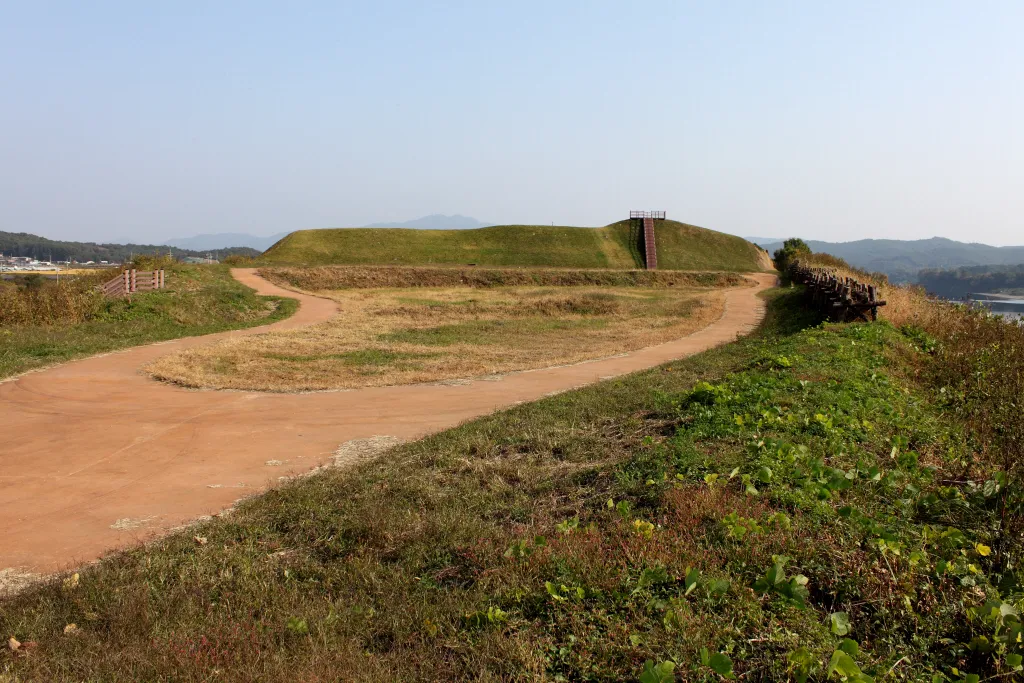
Horogoru Embankment, Yeoncheon
漣川 瓠蘆古壘
경기도 연천군
Basic information
- Designation
- Historic Site No.467
- Category
- Sites & Pagodas
- Designated year
- 2006
- Location
- 연천군, 경기도— 경기 연천군 장남면 원당리 1257-1번지 등
- Coordinates
- 37.985422, 126.859783
AI Docent
Coming soonAn AI-generated, friendly retelling of this heritage site is available in Korean. An English version is on our roadmap — for now, please see the official description below.
Description
The first record of Horogoru Embankment is found in Dongguk yeojido, a geography book published in 1656 (7th year of the reign of King Hyojong) and which states that it is the remains from the Three Kingdoms period. The first mention in an academic survey is found in Joseon gojeok josa bogo (Report on Korean Ancient Places) published in 1919. This report includes diagrams and photos and describes the fortress’s importance as a relic of the Three Kingdoms Period. Full-fledged excavation and studies were later carried out between 1991 and 2003. The fortress is located on top of a cliff of basalt rock beside Imjingang River, which flows from northeast to southwest. The walls have circumference of 400m, with the south wall measuring 161.9m, the north wall, 146m, and the remains of the east wall, 93m. Inside the walls, the height is 22m; the walls at the highest point reach 30m. Command posts have been erected both on the highest point of the east wall -- the highest of the four walls -- and at the end of the west wall. It is supposed that there is no other entrance to the fortress apart from that at the southern end of the east wall. Along with Yeoncheon’s Dangposeong Fortress (Historic Site No. 468) and Eundaeriseong Fortress (Historic Site No. 469), Horogoru Embankment in Yeoncheon is a unique riverside fortress located on a triangular piece of land formed where the Imjingang and Hantangang rivers meet. It was vital during the Three Kingdoms Period when the Imjingang served as a water boundary; hence its considerable academic importance as a cultural relic.
Location
지도를 불러오는 중…
Have you visited this place?
Log in and verify your visit on-site via GPS to record a stamp in My Journey. (QR verification coming later.)
Images: KOGL (khs.go.kr) · Data source: Korea Heritage Service Open API (khs.go.kr)