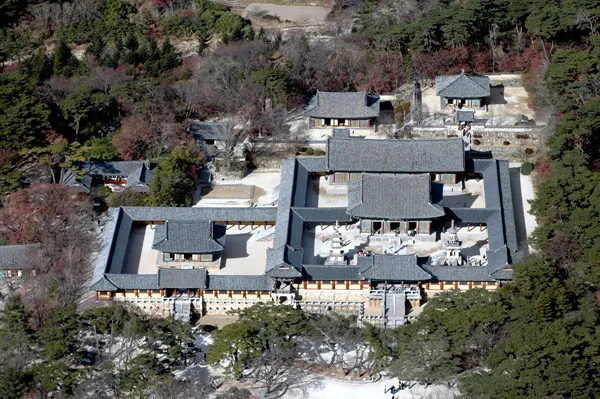
Bulguksa Temple, Gyeongju
慶州 佛國寺
경상북도 경주시
Basic information
- Designation
- Historic Site No.502
- Category
- 유적지
- Era
- 통일신라시대
- Designated year
- 2009
- Location
- 경주시, 경상북도— 경북 경주시 불국로 385, 등 (진현동)
- Coordinates
- 35.790157, 129.332056
AI Docent
✨ AI-generatedWelcome to Bulguksa Temple, one of Korea's most magnificent Buddhist treasures! Built between 751 and 774 during the Unified Silla Period, this temple sits beautifully on Tohamsan Mountain in Gyeongju. Imagine walking across the graceful stone bridges here—Cheongungyo and Baegungyo lead you toward Jahamun Gate, while Yeonhwagyo and Chilbogyo guide you to Geungnakjeon Hall. Each bridge is a national treasure in its own right. The temple's showstoppers are its two three-story stone pagodas, Dabotap and Seokgatap, which have stood for over 1,200 years. Inside, you'll find exquisite gilt-bronze Buddha statues that showcase the incredible craftsmanship of this golden age of Korean Buddhism. Though much was destroyed during the 1593 Japanese invasion, careful restoration between 1969 and 1973 brought this sacred place back to life. Together with nearby Seokguram Grotto, Bulguksa was recognized as a UNESCO World Heritage site in 1995. Come experience this remarkable testament to Korea's spiritual heritage.
⚠ This is an AI-generated retelling of the official description. For accuracy, refer to the official description below.
Description
The construction of Bulguksa Temple, located at Tohamsan Mountain, Gyeongju, was started in 751 (the 10th year of the reign of King Gyeongdeok of Silla) and completed in 774 (the 10th year of the reign of King Hyegong of Silla). Most of the buildings within the temple, except for Geungnakjeon Hall, Jahamun Gate, Beomyeongnu Pavilion and a few others, were burned down during the Japanese invasion in 1593. The present condition of the temple is the result of restoration work carried out between 1969 and 1973. The main features of the temple include two three-story stone pagodas, Dabotap and Seokgatap, which date back to the Unified Silla Period; two stone bridges, Cheongungyo (Blue Cloud Bridge) and Baegungyo (White Cloud Bridge), leading to Jahamun Gate; and two stone bridges, Yeonhwagyo (Lotus Flower Bridge) and Chilbogyo (Seven Treasure Bridge), leading to Geungnakjeon Hall, all of which have been designated as national treasures. Many cultural heritage items, including the Gilt-bronze Seated Vairocana Buddha kept in Birojeon Hall and the Gilt-bronze Seated Amitabha Buddha kept in Geungnakjeon Hall, attest to the splendid Buddhist culture of that period. The temple, along with Seokguram Grotto, was registered on the UNESCO World Heritage List in December 1995.
Location
지도를 불러오는 중…
Have you visited this place?
Log in and verify your visit on-site via GPS to record a stamp in My Journey. (QR verification coming later.)
Images: KOGL (khs.go.kr) · Data source: Korea Heritage Service Open API (khs.go.kr)