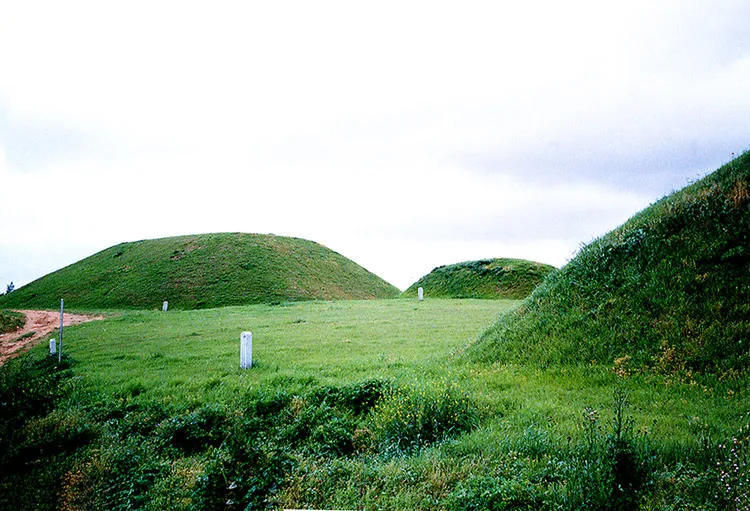
Ancient Tombs in Bannam, Naju
羅州 潘南 古墳群
전라남도 나주시
Basic information
- Designation
- Historic Site No.513
- Category
- 유적지
- Designated year
- 2011
- Location
- 나주시, 전라남도— 전남 나주시 반남면 대안리 103 등
- Coordinates
- 34.911609, 126.656309
AI Docent
Coming soonAn AI-generated, friendly retelling of this heritage site is available in Korean. An English version is on our roadmap — for now, please see the official description below.
Description
Bannam was an area along the Sampogang River where ancient cultures flourished. Around forty ancient tombs were discovered in the area (i.e. Daean-ri, Sinchon-ri, and Deoksan-ri during excavations carried out during the Japanese Occupation (1910-1945). Diverse relics have been unearthed from the tombs, such as unique large-sized jar coffins unlike any others found elsewhere in the country, and objects that display the status of the ruling class, such as gilt-bronze crown and shoes, and a sword with ring pommel and phoenix design. Jar coffin tombs are found only in areas along the Yeongsangang River, and are markedly different from the stone mound tombs of Goguryeo, the stone chamber tombs of Baekje and Gaya, and the wooden coffin tombs with stone mound of Silla. In the early period, such tombs were formed by burying about half of a jar coffin in a hole and then building a mound over it. Later, the mound was formed first and then the jar coffin was placed into a hole made at the top of the mound. Over time, larger mounds were also built. This style of jar coffin tomb was adopted in many areas around the world. In Korea, the practice appears to have been adopted during the Neolithic Age. As large jar coffins appear not to have been used elsewhere, this tomb system is thought to have been influenced by people in areas along the Yeongsangang River. Nine jar coffins, along with gold rings, large swords, bronze bracelets, glass beads, and potteries were unearthed from Tomb No. 9 in Daean-ri, which is the largest of the twelve tombs in the area. Nine jar coffin tombs are located in Sinchon-ri. Some of the tombs, including Tomb No. 9, were excavated during the Japanese Occupation (1910-1945), yielding a Gilt-bronze Crown (National Treasure No. 295) and shoes, gold rings, a sword with ring pommel and phoenix design, and bronze bracelets. During the excavation of Tomb No. 9 in Sinchon-ri in 1999, thirty-two cylinder-shaped pottery items, eventually found to be associated with the Haniwa (terracotta clay figures unearthed from ancient tombs) of Japan, were found around the top. This provides important clues for studying exchanges between Baekje and Japan in the ancient period. More than fourteen tombs are located in Deoksan-ri, which are thought to date back to the mid- to late-5th century, like those in Sinchon-ri and Daean-ri. Tomb No. 10 in Deoksan-ri, which dates from the latest period among those found in Bannam-myeon, is a stone chamber tomb. It is thought to have been made at a moment in the mid-6th century or perhaps a bit later, when the ruling class of the area fell under the domination of Baekje, resulting in the discontinuation of jar coffin tombs.
Location
지도를 불러오는 중…
Have you visited this place?
Log in and verify your visit on-site via GPS to record a stamp in My Journey. (QR verification coming later.)
Images: KOGL (khs.go.kr) · Data source: Korea Heritage Service Open API (khs.go.kr)