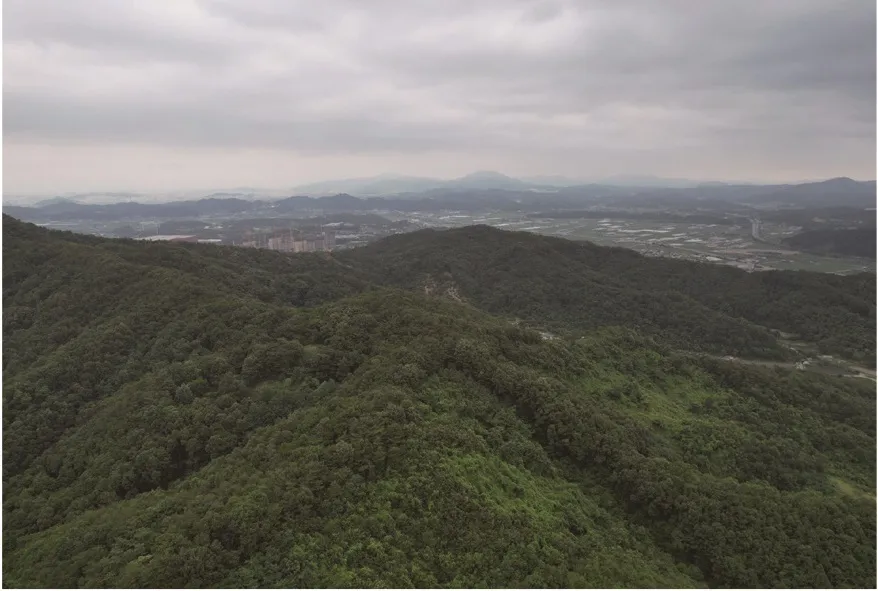
Daehaksan Bongsu Archaeological Site, Cheonan
第5路 直烽 - 天安 大鶴山 峰燧 遺蹟
충청남도 천안시
Basic information
- Designation
- Historic Site No.572-4
- Category
- Sites & Pagodas
- Era
- 조선시대
- Designated year
- 2023
- Location
- 천안시, 충청남도— 충청남도 천안시 동남구 광덕면 매당리 산 31-2 일원
- Coordinates
- 36.718621, 127.096670Kakao address conversion
AI Docent
Coming soonAn AI-generated, friendly retelling of this heritage site is available in Korean. An English version is on our roadmap — for now, please see the official description below.
Description
Machine-translatedThis English description was machine-translated and may contain inaccuracies. Refer to the original Korean text for details.
The 'bongsu (烽燧)', the communication system of the Joseon Dynasty, was installed to notify the central Ministry of War (Byeongjo) and local administrative centers (eupchi) of enemy invasions through fire signals at night and smoke signals during the day, according to agreed-upon signaling protocols. The network originated from major endpoints in the north and south and converged at Mokmyeoksan in Seoul (present-day Namsan). According to the Revised and Supplemented Comprehensive Repository of Documents (증보문헌비고, 1908), the late Joseon central government operated 5 direct beacon lines (jikbong) and 23 auxiliary beacon lines (ganbong), with a total of 622 beacons throughout all routes. Among these, the "Second Direct Beacon Line (제2로 직봉)" connecting Busan's Eungbong to Seoul's Mokmyeoksan Second Beacon, and the "Fifth Direct Beacon Line (제5로 직봉)" connecting Dolsan Island in Yeosu, South Jeolla Province to Seoul's Mokmyeoksan Fifth Beacon are located in South Korea, while the remaining three direct beacon lines are located in North Korea. * Ganbong (間峯): beacons located on auxiliary routes established to compensate for potential breaks in direct beacon lines. During the Joseon Dynasty, Japanese pirates (waegu) utilized maritime routes to invade not only inland areas of the southern coast near Tsushima but also distant regions such as Ganghwa Island. The majority of beacons on the "Fifth Direct Beacon Line" were strategically positioned to monitor the sea routes through which these Japanese pirates infiltrated, and under the management of naval commanders (susa), they functioned primarily as fortifications (yosaek). This distinguishes them from the "Second Direct Beacon Line," which was previously designated as a historic site and operated under the management of military commanders (byeongsa) primarily for the purpose of urgent communication (geupbo).
Location
지도를 불러오는 중…
Have you visited this place?
Log in and verify your visit on-site via GPS to record a stamp in My Journey. (QR verification coming later.)
Images: KOGL (khs.go.kr) · Data source: Korea Heritage Service Open API (khs.go.kr)