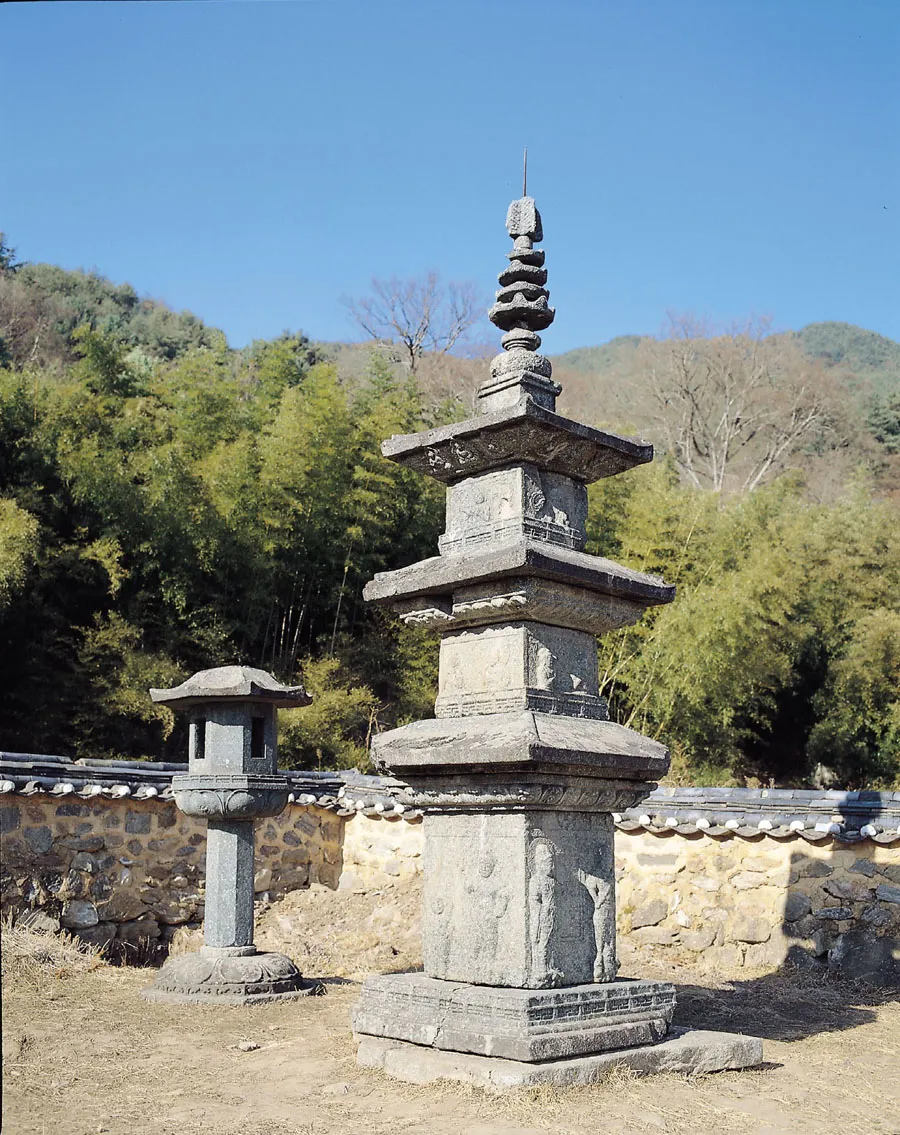
Three-story Stone Pagoda at Baekjangam Hermitage of Silsangsa Temple, Namwon
南原 實相寺 百丈庵 三層石塔
전북특별자치도 남원시
Basic information
- Designation
- National Treasure No.10
- Category
- Sites & Pagodas
- Era
- 통일신라시대 9세기
- Designated year
- 1962
- Location
- 남원시, 전북특별자치도— 전라북도 남원시 산내면 대정리 975
- Coordinates
- 35.442539, 127.619972
AI Docent
Coming soonAn AI-generated, friendly retelling of this heritage site is available in Korean. An English version is on our roadmap — for now, please see the official description below.
Description
This three-story stone pagoda is situated on a stretch of arable land below Baekjangam, a small hermitage located some distance to the north of Silsangsa Temple, which was built by Hongcheok, a Buddhist monk, in 828 (the 3rd year of the reign of King Heungdeok of Unified Silla) to the west of Cheonwangbong Peak in Jirisan Mountain. Erected on a low platform, the pagoda has a unique structure and exhibits a kind of decorative variation characterized by unique styles and skills. Generally speaking, pagodas taper towards the top, but this pagoda maintains a consistent width and height at each floor. The roofstone also differs markedly from the usual style of the period in that it is a single roofstone without making multiple stories. Another atypical characteristic of this pagoda is that it displays diverse carvings from the platform to the roofstone. The platform and support of the body are decoratively carved with railings; the first floor of the body, with a Bodhisattva and divine guardians; the second floor, with Apsaras playing a musical instrument; and the third floor, with seated Apsaras. Lotus flower designs are carved at the bottom of the roofstone, while Buddha triad is only on the roof support of the third floor. The pagoda is notable for the exquisite images carved on its surface, and its free structure, which eschews formality as a whole. It is widely regarded as one of the most beautiful stone pagodas of the late Unified Silla Period.
Location
지도를 불러오는 중…
Have you visited this place?
Log in and verify your visit on-site via GPS to record a stamp in My Journey. (QR verification coming later.)
Images: KOGL (khs.go.kr) · Data source: Korea Heritage Service Open API (khs.go.kr)