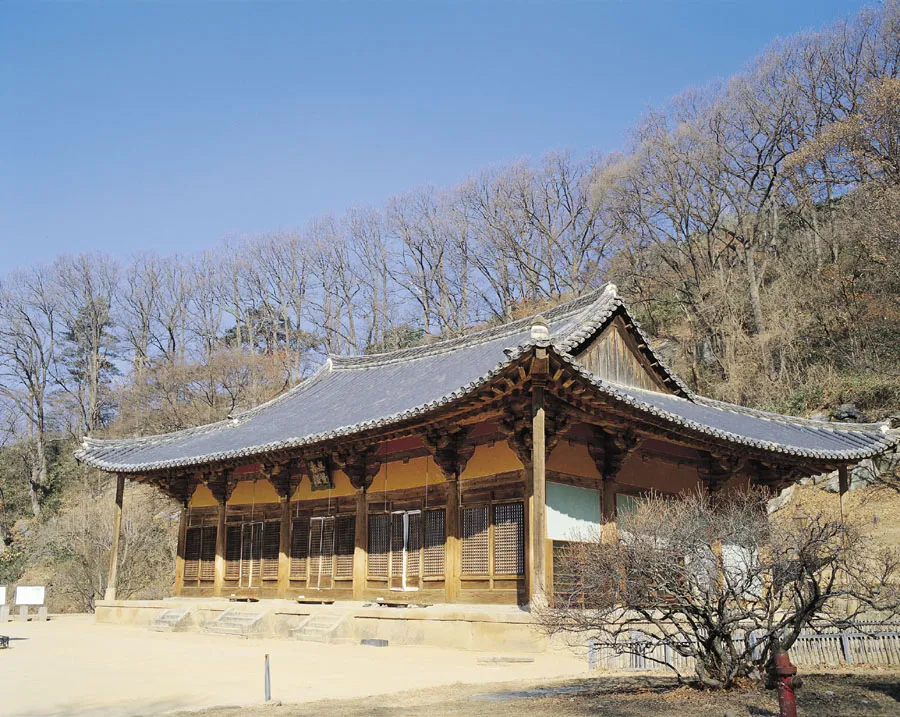
Muryangsujeon Hall of Buseoksa Temple, Yeongju
榮州 浮石寺 無量壽殿
경상북도 영주시
Basic information
- Designation
- National Treasure No.18
- Category
- Architecture
- Era
- 고려시대 중기
- Designated year
- 1962
- Location
- 영주시, 경상북도— 경상북도 영주시 부석사로 345 (부석면, 부석사)
- Coordinates
- 36.998954, 128.687486
AI Docent
✨ AI-generatedWelcome to Muryangsujeon Hall at Buseoksa Temple! Imagine stepping into one of Korea's most precious wooden structures, nestled on a mountainside in Yeongju. This hall carries over 1,300 years of history. Founded in 676 by the Buddhist monk Uisang, the temple became legendary through a beautiful tale: a devoted woman transformed into a dragon to follow Uisang home from China, protecting this sacred place. The hall you see today is a survivor. Though it burned in 1358, monks rebuilt it in 1376 with remarkable care. Later, vibrant decorative paintings were added during the 1600s. What makes Muryangsujeon Hall extraordinary? It's the second oldest wooden building in Korea, and its elegant bracket system—the wooden joints that hold it together—became the textbook example for traditional Korean Buddhist architecture. Notice something unique: the Amitabha Buddha sits on the western wall, not the center. This distinctive placement, combined with the hall's graceful proportions, makes it a masterpiece worth traveling to experience firsthand.
⚠ This is an AI-generated retelling of the official description. For accuracy, refer to the official description below.
Description
Buseoksa Temple, located on the hillside of Bonghwangsan Mountain, was built by Buddhist monk Uisang in 676 (the 16th year of the reign of King Munmu of the Silla Dynasty) by royal order. According to Samguk yusa (Memorabilia of the Three Kingdoms), a woman who adored Uisang was transformed into a dragon and followed him to this area upon his return form a period of study in the Tang Dynasty. Then she defeated a band of thieves hiding out in this area before resting behind Muryangsujeon Hall. Muryangsujeon Hall was built as the main prayer hall of Buseoksa Temple, and now houses a statue of Amitabha Buddha. It was originally built during the reign of King Munmu (r. 661-681) of Silla, and Unfortunately, the hall was burnt down in 1358 (the 7th year of King Gongmin’s reign), but was reconstructed in 1376 (the 2nd year of King U’s reign), and then embellished with a multi-colored decorative painting during the reign of King Gwanghaegun (r. 1608-1623) of the Joseon Dynasty. An Amitabha Buddha is enshrined on the western wall of the hall, unlike other Buddhist temples in which Buddhist statues are usually placed at the center of the main hall. Muryangsujeon Hall is the second oldest wooden building in Korea next to Geungnakjeon Hall of Bongjeongsa Temple in Andong. With its graceful column bracket system, this hall is regarded as a standard structure for students of the structure and formality of traditional Buddhist architecture in Korea.
Location
지도를 불러오는 중…
Have you visited this place?
Log in and verify your visit on-site via GPS to record a stamp in My Journey. (QR verification coming later.)
Images: KOGL (khs.go.kr) · Data source: Korea Heritage Service Open API (khs.go.kr)