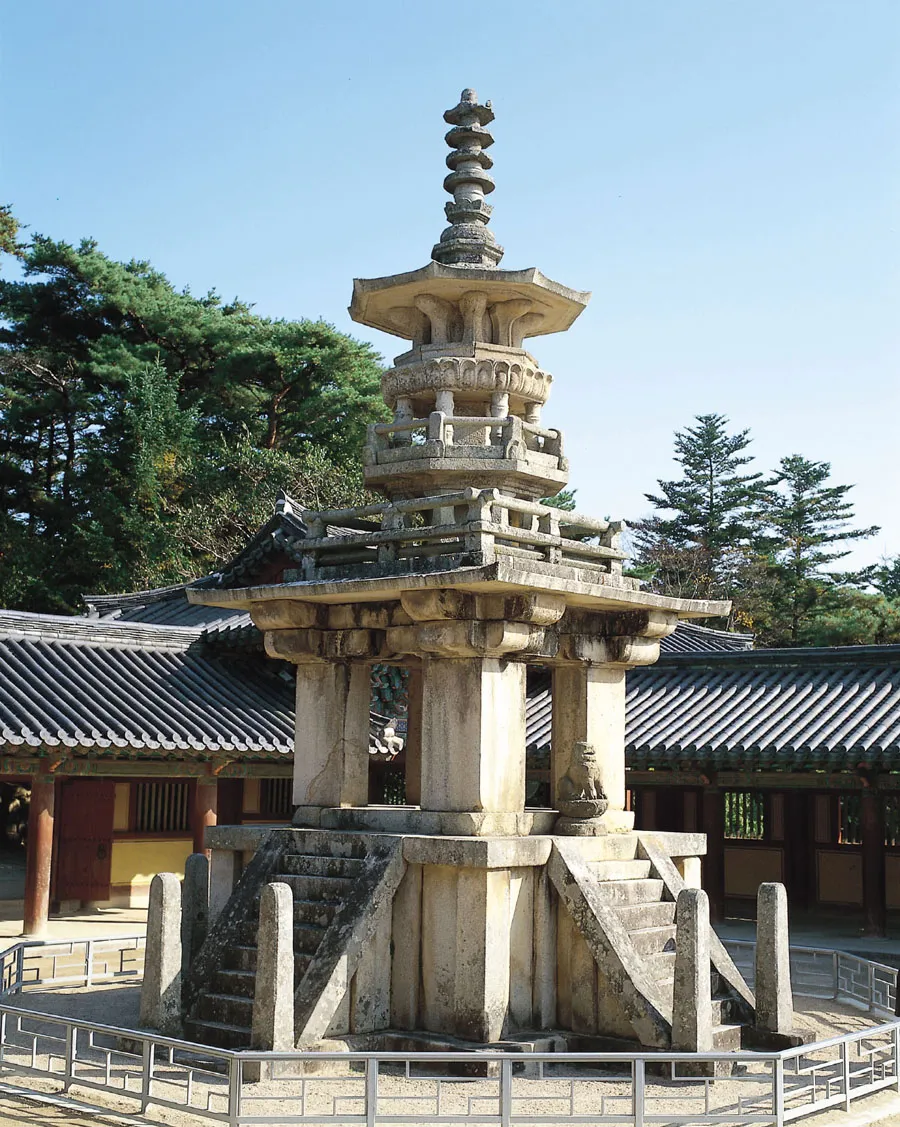
Dabotap Pagoda of Bulguksa Temple, Gyeongju
慶州 佛國寺 多寶塔
경상북도 경주시
Basic information
- Designation
- National Treasure No.20
- Category
- Sites & Pagodas
- Era
- 통일신라시대 8세기
- Designated year
- 1962
- Location
- 경주시, 경상북도— 경북 경주시 불국로 385, 불국사 (진현동)
- Coordinates
- 35.789970, 129.332268
AI Docent
✨ AI-generated# Dabotap Pagoda of Bulguksa Temple Welcome! You're standing before one of Korea's most extraordinary stone pagodas, built over 1,200 years ago during the Unified Silla period. What makes Dabotap truly special is its bold, unique design—unlike anything else you'll see. Imagine this: two magnificent pagodas face each other here, each about 10 meters tall. Dabotap stands to the east, Seokgatap to the west. They represent two Buddhas from the Lotus Sutra—the Buddha of the past and the Buddha of the present—proving the truth of Buddhist teachings by standing side by side. Look closely at Dabotap's structure. Its cross-shaped platform has stone staircases on each side, supporting an octagonal tower wrapped in square railings. Geometric perfection—squares, octagons, circles—all precisely proportioned. It's a masterpiece of stone carving that captures the intricate beauty of wooden architecture. The temple was founded in 751 by Kim Dae-seong as an offering for his parents. This pagoda expresses the spiritual world of Silla people, representing their Buddhist paradise where past, present, and future exist together. Come closer and observe the craftsmanship that shaped Korean culture.
⚠ This is an AI-generated retelling of the official description. For accuracy, refer to the official description below.
Description
Dabotap Pagoda and Seokgatap Pagoda (the Three-story Stone Pagoda of Bulguksa Temple, National Treasure No. 21) are the two most renowned pagodas in Korea. They are similar in height (10.29m and 10.75m), and stand facing each other, Dabotap Pagoda in the east, Seokgatap Pagoda in the west, between Daeungjeon Hall and Jahamun Gate of Bulguksa Temple . Dabotap is a unique type of pagoda, while Seokgatap Pagoda (also known as “Sakyamuni Buddha Pagoda”) is representative of the more general type of stone pagoda. The two pagodas were built at the same site to reflect the content of the Saddharmapundarika Sutra (The Lotus Sutra), in which the Dabo Buddha (“Buddha of the past”) stands beside Sakyamuni (“Buddha of the present”) to prove that his Buddhist sermon is right. Bulguksa Temple was founded by Kim Dae-seong’s offer in 751 (the 10th year of the reign of King Gyeongdeok of Silla). Samguk yusa (Memorabilia of the Three Kingdoms) states that Kim Dae-seong built Seokguram Grotto for his parents in his former life, and Bulguksa Temple for his present parents. However, the temple was not completed at the time of his death, so it was finished afterwards by the kingdom, and in the end, the temple was run not for the private individual Kim Dae-seong but for the benefit of the kingdom as a whole. Bulguksa Temple can be said to be the realization of the Buddhist paradise in which Buddhist monks of past, present, and future live together. It clearly reveals aspects of the spiritual world of the people of Silla. While it is perfectly clear that Seokgatap Pagoda is a three-story pagoda standing on a two-story platform, it is difficult to count the number of stories of Dabotap Pagoda. In fact, even experts have diverging opinions, with some saying it is has four stories and others that it has only three. However, the uniqueness of Dabotap Pagoda can be seen in the structure of each part. Stone staircases are attached to each side of the cross-shaped platform, with an octagonal pagoda body surrounded by square railings placed upon it. It is presumed that the pagoda was built in 751 during the construction of Bulguksa Temple. This work is a masterpiece that beautifully expresses the complicated structure of wooden construction without any distraction by the use of through novel ideas. The work exhibits the artistic sensibility of Unified Silla through its well-organized structure consisting of squares, octagons, and circles, and in its length, width and thickness, which are standardized in every part. During the Japanese Colonial Period, the Japanese dismantled and repaired the pagoda around 1925, but they left behind no records of this work. In the process, Artifact, reliquaries, and other artifacts that must have been placed inside the pagoda all disappeared. In addition, of the four lions originally placed on the stone staircases of the pagoda, the Japanese took away three, all of which must have been in good condition. Though there have been continuous efforts to retrieve these precious cultural heritages, no trace has been found of them as yet.
Location
지도를 불러오는 중…
Have you visited this place?
Log in and verify your visit on-site via GPS to record a stamp in My Journey. (QR verification coming later.)
Images: KOGL (khs.go.kr) · Data source: Korea Heritage Service Open API (khs.go.kr)