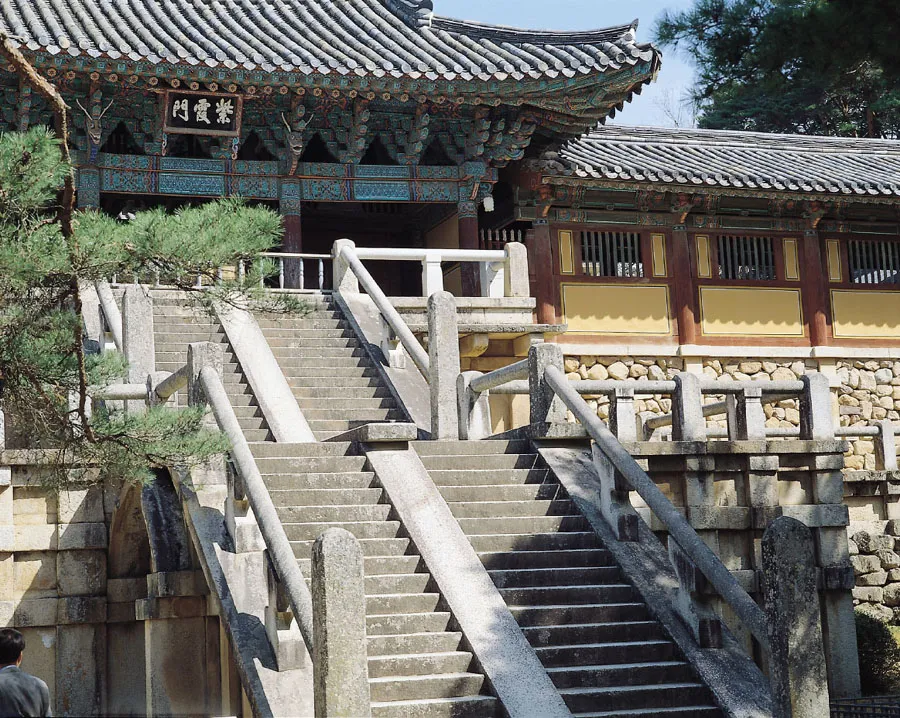
Cheongun and Baegun Stone Bridges of Bulguksa Temple, Gyeongju
慶州 佛國寺 靑雲橋 및 白雲橋
경상북도 경주시
Basic information
- Designation
- National Treasure No.23
- Category
- Sites & Pagodas
- Era
- 통일신라시대
- Designated year
- 1962
- Location
- 경주시, 경상북도— 경북 경주시 불국로 385, 불국사 (진현동)
- Coordinates
- 35.789723, 129.332158
AI Docent
✨ AI-generatedWelcome to one of Korea's most enchanting stone bridges! As you stand before Cheongungyo and Baegungyo at Bulguksa Temple, you're looking at over 1,270 years of history—structures from the Unified Silla period that have survived virtually untouched. These aren't ordinary bridges; they're spiritual pathways. The sixteen steps of Cheongungyo represent the vigor of youth, while the eighteen steps of Baegungyo symbolize the wisdom of age. Together, they guide you from the everyday world below toward the sacred halls of Buddha above. What makes them truly special? That graceful rainbow-shaped arch underneath. Imagine water cascading down from a device on the left, creating actual rainbows in the spray—poetry in stone. This arch also marks a milestone in Korean engineering: it's among the earliest evidence of sophisticated stone arches in the peninsula. These 34 steps, precisely angled at 45 degrees, are the only surviving Silla-period bridges of their kind. Come experience where Buddhist devotion meets architectural brilliance.
⚠ This is an AI-generated retelling of the official description. For accuracy, refer to the official description below.
Description
Daeungjeon and Geungnakjeon, the prayer halls of Bulguksa Temple, can be reached by two ways – via Cheongungyo and Baegungyo Bridges to the east, or via Yeonhwagyo and Chilbogyo Bridges to the west. Cheongungyo and Baegungyo Bridges are connected to Jahamun Gate, which leads to Daeungjeon Hall, and are considered to be symbolic structures that connect the world of common people under the bridge with the world of Buddha over it. The bridges consist of thirty-four steps of which the sixteen steps forming the upper part are called Cheongungyo Bridge and the eighteen steps forming the lower part are called Baegungyo Bridge. These bridges are sometimes compared to life itself, the former standing for ‘green youth’ and the latter for ‘white-haired elders’. The structure is unique in bridge-shaped staircase, and the climbing slope is elaborately trimmed in 45 degrees. Since the under part of the bridges is rainbow-shaped arch, it make smooth and vital the view that is hardened by the rectilinear lines. It is said that there used to be a pond under the reinforced stonewall where the bridges are. Even now, a device making water fall down remains to the left of the staircase. It is said that when water fell from here, a rainbow was created by the spray from the falling water. Presumed to have been built in 751 (the 10th year of the reign of King Gyeongdeok of Unified Silla), these structures are very precious because they are the only bridges of the Silla Period to have survived fully intact. Furthermore, the rainbow-shaped arch of the under part is of great significance as it provides an indication of the earliest use of arches in stone bridges and fortress gates.
Location
지도를 불러오는 중…
Have you visited this place?
Log in and verify your visit on-site via GPS to record a stamp in My Journey. (QR verification coming later.)
Images: KOGL (khs.go.kr) · Data source: Korea Heritage Service Open API (khs.go.kr)