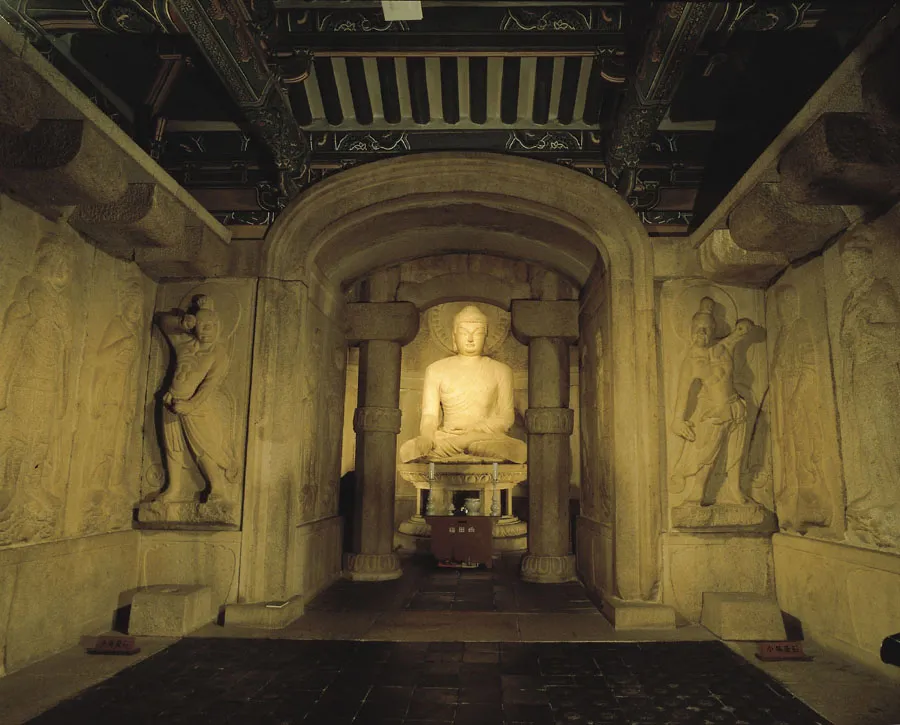
Gyeongju Seokguram Grotto
慶州 石窟庵 石窟
경상북도 경주시
Basic information
- Designation
- National Treasure No.24
- Category
- Architecture
- Era
- 통일신라시대
- Designated year
- 1962
- Location
- 경주시, 경상북도— 경상북도 경주시 석굴로 238(진현동, 석굴암)
- Coordinates
- 35.794852, 129.349242
AI Docent
✨ AI-generated# Welcome to Seokguram Grotto Imagine stepping into a masterpiece carved from white granite over 1,200 years ago. In 751, Prime Minister Kim Dae-seong began an extraordinary project: creating an artificial stone temple halfway up Tohamsan Mountain. Twenty-three years later, workers completed this architectural miracle. You'll enter through a rectangular chamber guarded by powerful deities, then move down a corridor lined with guardian kings. The corridor opens into a round main chamber—its ceiling an engineering marvel made from over 360 precisely fitted stones. At the chamber's heart sits Sakyamuni Buddha, radiating serenity, while around him stand nearly forty sculpted figures: bodhisattvas, disciples, and celestial beings. Every statue here is exquisite. Look especially for the Eleven-faced Avalokitesvara behind the main Buddha—its graceful lines showcase peak Buddhist artistry. The artists combined mathematics, geometry, and spiritual vision flawlessly. This grotto represents Silla's golden age of Buddhist culture, a time when art and faith merged into something transcendent. You're standing in a UNESCO World Heritage site that still whispers its ancient wisdom.
⚠ This is an AI-generated retelling of the official description. For accuracy, refer to the official description below.
Description
The construction of Seokguram Grotto was begun in 751 under the leadership of Prime Minister Kim Dae-seong during the reign of King Gyeongdeok of the Silla Dynasty, and was completed in 774 (the 10th year of King Hyegong’s reign), whereupon it was given its original name of Seokbulsa Temple. Buddhist art reached its peak during King Gyeongdeok’s reign, which spanned the middle period of the Silla Period, Besides Seokguram Grotto, many other cultural treasures were built during this period, including Bulguksa Temple, Dabotap Pagoda, the Three-story Stone Pagoda of Bulguksa Temple, and the Bell of Hwangnyongsa Temple. The artificial stone grotto was built halfway down Tohamsan Mountain with pieces of white granite. The principal statue of Sakyamuni Buddha was placed at the center of the grotto, and forty statues of various bodhisattvas, Buddha’s disciples, and guardian kings were carved on the surrounding walls, though only thirty-eight of them remain. The rectangular front chamber of the grotto is connected to the round main chamber by a corridor. The exquisite ceiling of the main chamber was made with more than 360 flat stones. The architectural technique used to build this grotto is unprecedented in its excellence. There are statues of four guardian deities on both the left and right sides of the front chamber, which functions as the entrance to the main chamber. Carved on both sides of the entrance to the corridor is a statue of the Vajra Guardians, while the narrow corridor is decorated with the Four Guardian Kings carved in pairs. There is an octagonal stone column on both sides of the entrance to the round main chamber. The Principal Buddha is placed slightly off center toward the back of the main chamber. From the entrance, the walls of the chamber are filled with the images of two devas, two bodhisattvas, and ten arhats. Standing behind the Principal Buddha is a statue of the Eleven-faced Avalokitesvara Bodhisattva, perhaps the most exquisitely carved statue found inside this grotto. Every single sculpture contained in the grotto may be considered a masterpiece of East Asian Buddhist art. The list of masterpieces includes the principal image of Buddha, which was created with mature carving skills; the Eleven-faced Avalokitesvara Bodhisattva with its magnificently carved face and body; statues of valiant warriors and the majestic Four Guardian Kings; and the supple graceful statues of various bodhisattvas and arhats, each of which displays a distinctive individuality. In particular, the serene appearance of the Principal Buddha enshrined in the main chamber deepens the mystical atmosphere. The extremely natural appearance of the Principal Buddha seems to present to all living people the ideal model of a man harboring a profound and sublime mind deep within him and easily pass to them his everlasting mercy. Seokguram Grotto is a masterpiece of the golden age of Buddhist art in Silla. What makes it stand out all the more is its perfect combination of architecture, mathematics, geometry, religion, and art. Seokguram Grotto has long been preserved as National Treasure No. 24, and was jointly registered as a UNESCO World Heritage in December 1995 along with Bulguksa Temple.
Location
지도를 불러오는 중…
Have you visited this place?
Log in and verify your visit on-site via GPS to record a stamp in My Journey. (QR verification coming later.)
Images: KOGL (khs.go.kr) · Data source: Korea Heritage Service Open API (khs.go.kr)