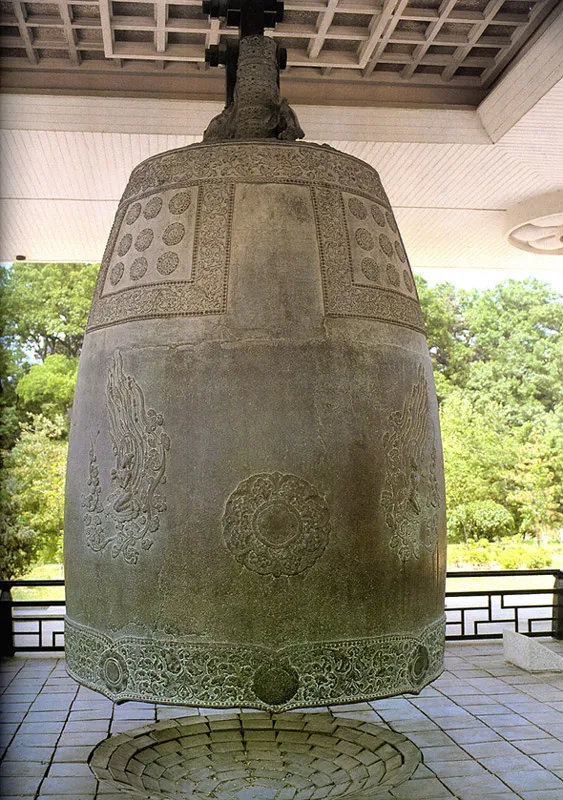
Sacred Bell of Great King Seongdeok
聖德大王神鍾
경상북도 경주시
Basic information
- Designation
- National Treasure No.29
- Category
- Craft
- Era
- 통일신라 혜공왕 7년(771)
- Designated year
- 1962
- Location
- 경주시, 경상북도— 경북 경주시 일정로 186, 국립경주박물관 (인왕동,국립경주박물관)
- Coordinates
- 35.829387, 129.227912
AI Docent
Coming soonAn AI-generated, friendly retelling of this heritage site is available in Korean. An English version is on our roadmap — for now, please see the official description below.
Description
The Sacred Bell of Great King Seongdeok is the largest bell in Korea, measuring 3.75 m in height, 2.27 m in diameter (at the rim), and 11-25 cm in thickness (of the wall), and weighing about 18.9 tons. King Gyeongdeok of Silla commissioned the casting of the bell to honor the virtue of his father King Seongdeok, but he didn’t live to see its completion. It was eventually completed in 771, during the reign of King Hyegong, the son of King Gyeongdeok, and was named the Sacred Bell of King Seongdeok. The bell is also known as the Bell of Bongdeoksa Temple, because it was hung at the temple at first; and as the Emille Bell, a name which derives from a legend that a baby was sacrificed to produce this bell. It has a hollow tube on top that is designed to control the tone - a unique feature of Korean bronze bells - and a hook carved in the shape of a dragon’s head next to the tube that was used for hanging the bell. The bell is carved with a number of splendid patterns that represent the zenith of Silla art: There are two wide bands featuring flower patterns in relief around the bell’s mouth and shoulder, and below the shoulder bands there are four square blocks, each containing nine embossed designs in the shape of lotus flowers. Two pairs of Apsaras (Celestial Maiden) are cast in relief below the square blocks, and two striking points are raised in the shape of a lotus flower between the Apsaras. The bell’s mouth has several rhombic edges, showing a unique style. The bell also contains two inscriptions concerning its production. Consisting of about one thousand Chinese characters, they attest to the brilliant writing and carving style of the period, and have been well preserved for nearly 1300 years.
Location
지도를 불러오는 중…
Have you visited this place?
Log in and verify your visit on-site via GPS to record a stamp in My Journey. (QR verification coming later.)
Images: KOGL (khs.go.kr) · Data source: Korea Heritage Service Open API (khs.go.kr)