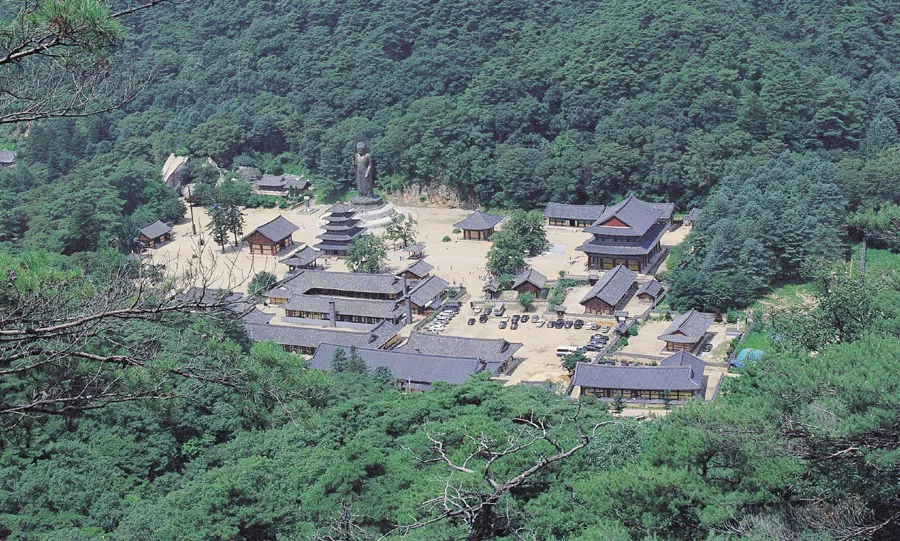
Palsangjeon Wooden Pagoda of Beopjusa Temple, Boeun
報恩 法住寺 捌相殿
충청북도 보은군
Basic information
- Designation
- National Treasure No.55
- Category
- Sites & Pagodas
- Era
- 조선 인조 2년(1625)
- Designated year
- 1962
- Location
- 보은군, 충청북도— 충북 보은군 속리산면 법주사로 379, 법주사 (사내리)
- Coordinates
- 36.541942, 127.833098
AI Docent
Coming soonAn AI-generated, friendly retelling of this heritage site is available in Korean. An English version is on our roadmap — for now, please see the official description below.
Description
Palsangjeon Wooden Pagoda is the only wooden pagoda in Korea, which was built before the modern period and still stands in the precincts of Beopjusa Temple. The temple was established in 553 by a Silla monk named Uisin who had studied Buddhism in India. The current pagoda, a five-story structure, was erected after the Japanese Invasion of Korea in 1592 and rebuilt after being dismantled in 1968. The name of the pagoda, which literally means “Hall of Eight Phases,” came from the hanging paintings depicting the eight important phases in the life of Shakyamuni Buddha. The first and second stories of the pagoda feature five kan (a unit of measurement referring to the distance between two columns) on all four sides, and the third and fourth stories, three kan; the fifth story has two kan. The wooden structure is set up on a stone base that is comfortably low, with four staircases one on each side. The pagoda is covered with a pyramidal roof with a finial on top. The pagoda is also characterized by the use of ornamental brackets placed on top of the columns in all stories except in the top story where the brackets are set not only on top but between the columns as well. The interior of the pagoda is largely divided into three areas: the first area enshrines the relics of eminent monks; the second area houses Buddha statues and paintings depicting the eight major phases of Shakyamuni’s life; the third area is used for prayer meetings. Palsangjeon Pagoda of Beopjusa Temple is the tallest among the pagodas in Korea and the only wooden pagoda remaining today, making it an invaluable part of Korean cultural and historical heritage.
Location
지도를 불러오는 중…
Have you visited this place?
Log in and verify your visit on-site via GPS to record a stamp in My Journey. (QR verification coming later.)
Images: KOGL (khs.go.kr) · Data source: Korea Heritage Service Open API (khs.go.kr)