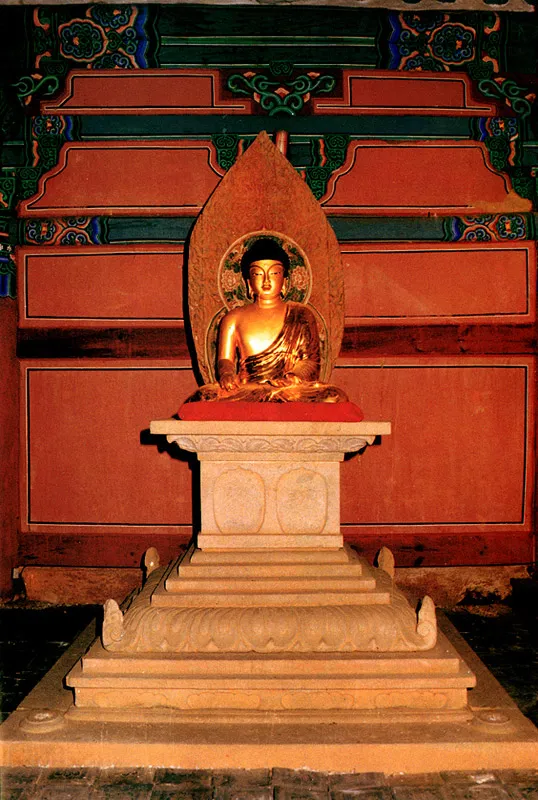
Iron Seated Bhaisajyaguru Buddha and Stone Pedestal of Janggoksa Temple, Cheongyang
靑陽 長谷寺 鐵造藥師如來坐像 및 石造臺座
충청남도 청양군
Basic information
- Designation
- National Treasure No.58
- Category
- Sculpture
- Era
- 통일신라 후반
- Designated year
- 1962
- Location
- 청양군, 충청남도— 충남 청양군 대치면 장곡리 14번지 장곡사
- Coordinates
- 36.417306, 126.859565
AI Docent
Coming soonAn AI-generated, friendly retelling of this heritage site is available in Korean. An English version is on our roadmap — for now, please see the official description below.
Description
This cast iron statue of Bhaisajyaguru Buddha (Medicine Buddha) is enshrined in Sangdaeungjeon Hall (Treasure No. 162) of Janggoksa Temple located in Chilgapsan Mountain, Cheongyang-gun, Chungcheongnam-do. Seated on a tall, rectangular pedestal, the statue has a wooden halo. The Buddha features a topknot (usnisa), a round, graceful face, and a stout, imposing body, but the lack of volume suggests that it was made in the late 9th century. He also has the fingers of his right hand pointing to the ground and his left hand placed on his lap. It is said that there had originally been a medicine jar on the left hand but is now missing. The robe is loosely draped from the left shoulder, exposing the right shoulder and creating many folds as it covers the Buddha’s lower body. The rectangular pedestal is roughly divided into three parts; the lower part is tall and large, whereas the middle and upper parts are comparatively low and small. The base is conspicuously wide with postholes on all four corners, suggesting that the statue was originally protected by a canopy or housed in a shrine. Carved with lotus petals, the lower part of the pedestal has floral carvings of considerable size on all four corners, whereas the cubic middle part has two “elephant eyes” carved on each of its four faces and the upper part carved with a lotus flower in full bloom. Art historians believe that the statue originally had a stone halo that was replaced by the current wooden halo during the Joseon Period (1392-1910). The halo consists of two parts -- the inner part decorated with a floral design and the outer part with a flame design – suggesting that it copied the halos that were the trend during the period between the late Unified Silla (676-935) and early Goryeo Periods (918-1392). The cast iron Bhaisajyaguru in Janggoksa Temple is a masterpiece of the early 10th-century Buddhist sculpture and is particularly regarded highly for the distinctive pagoda-shaped pedestal, design intended to have its own shrine, and style of cast iron statues established in the late 9th century.
Location
지도를 불러오는 중…
Have you visited this place?
Log in and verify your visit on-site via GPS to record a stamp in My Journey. (QR verification coming later.)
Images: KOGL (khs.go.kr) · Data source: Korea Heritage Service Open API (khs.go.kr)