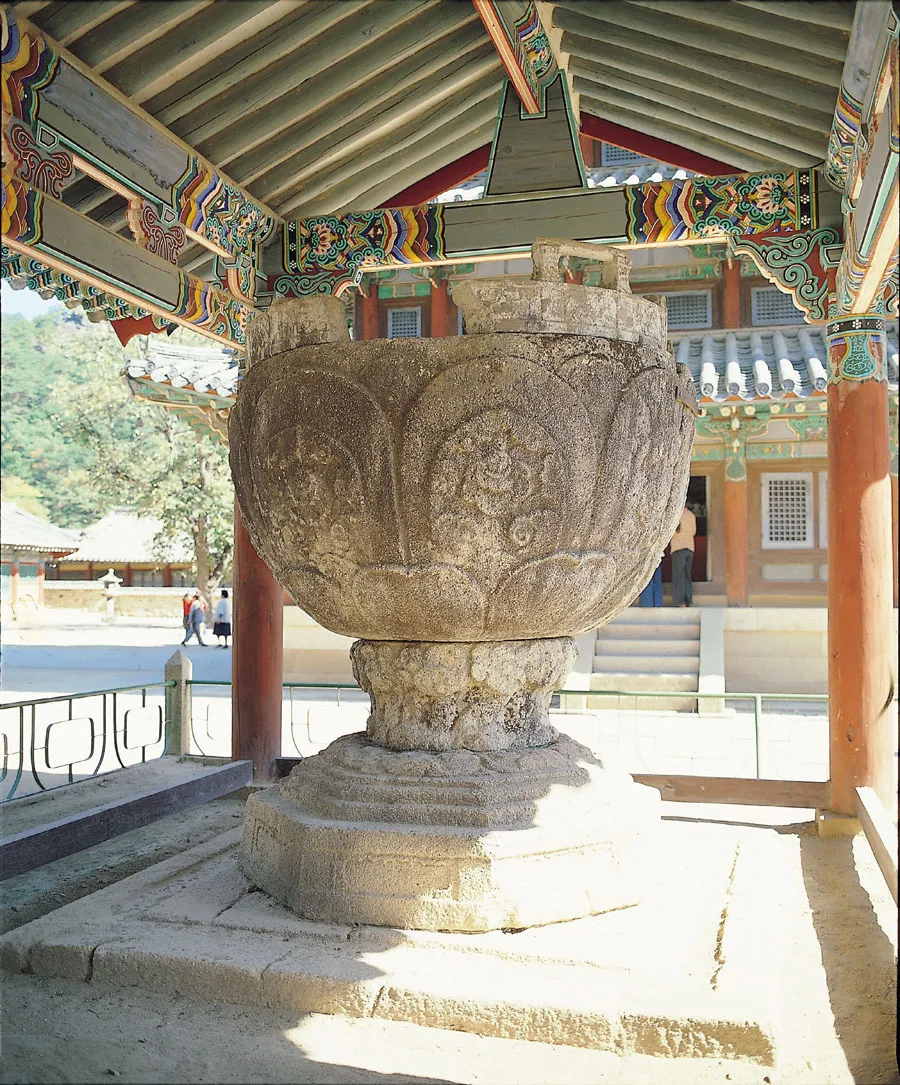
Stone Lotus Basin of Beopjusa Temple, Boeun
報恩 法住寺 石蓮池
충청북도 보은군
Basic information
- Designation
- National Treasure No.64
- Category
- Sites & Pagodas
- Era
- 통일신라시대
- Designated year
- 1962
- Location
- 보은군, 충청북도— 충북 보은군 속리산면 법주사로 405-9, 법주사 (사내리)
- Coordinates
- 36.541486, 127.832484
AI Docent
Coming soonAn AI-generated, friendly retelling of this heritage site is available in Korean. An English version is on our roadmap — for now, please see the official description below.
Description
This large stone basin, located in the precincts of Beopjusa Temple, is shaped like a lotus blossom and is known to have been used as a lotus pond. In the temple are many religious objects inspired by lotus, which symbolizes the Buddhist pure land of supreme bliss. The lotus basin consists of an octagonal base, a pedestal carved with mushroom-shaped clouds, and the main body shaped like a half-bloomed lotus flower and hollowed out to form a large bowl used to hold a large volume of water. The basin is large and deep enough to fulfill its practical purpose, featuring an attractively voluminous body with elaborately ornamented outer surface. The decoration of the basin’s outer surface consists of a band of small lotus petals encircling the base, with large double-layered lotus petals – each of which contains an exuberant floral design – occupying a much larger area of the surface. There is a fairly large vertical crack running vertically down from the rim, and an iron clamp is used to prevent further damage by the crack. The basin is also marked by double stone railings consisting of rails supported by posts built one upon the other along the rim. The lower railing consists of a rail supported by square posts carved in low relief, and the walls between the posts are lavishly adorned with different decorative motifs. Meanwhile, the posts of the upper railing are highly regarded for their unique aesthetic merit and are often compared with the stone railings of the Dabotap Pagoda of Bulguksa Temple. Known to have been made by Unified Silla artisans around the 8th century, this stone lotus basin is widely praised for its subtle splendor and elegant shape and is generally regarded as one of the finest examples of its kind remaining today.
Location
지도를 불러오는 중…
Have you visited this place?
Log in and verify your visit on-site via GPS to record a stamp in My Journey. (QR verification coming later.)
Images: KOGL (khs.go.kr) · Data source: Korea Heritage Service Open API (khs.go.kr)