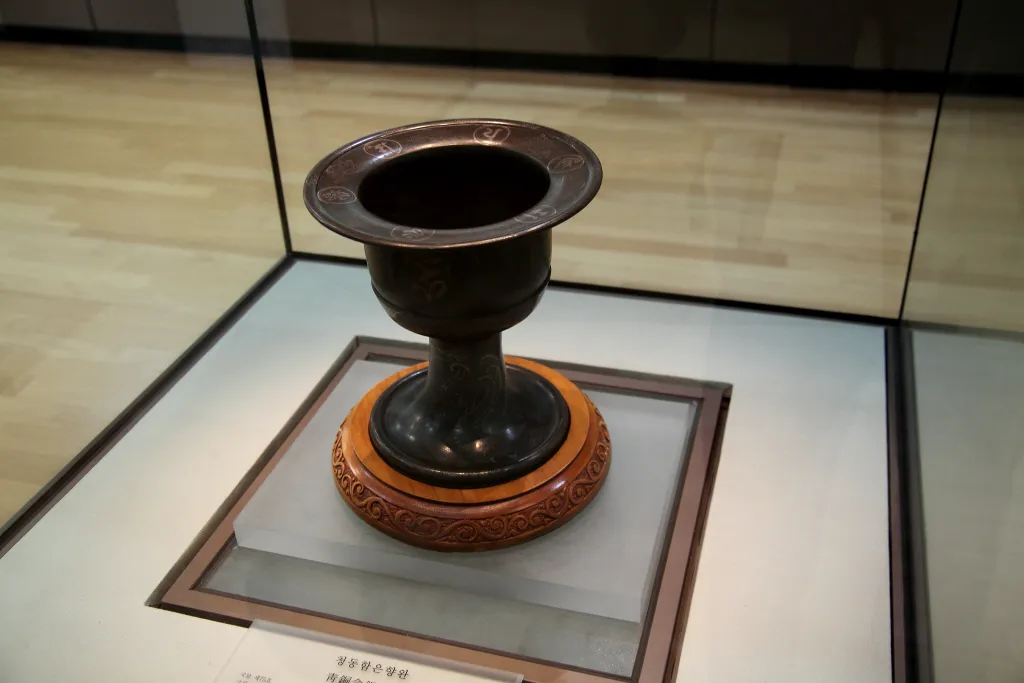
Bronze Incense Burner with Silver-inlaid Design of Pyochungsa Temple
表忠寺 靑銅 銀入絲 香垸
경상남도 밀양시
Basic information
- Designation
- National Treasure No.75
- Category
- Craft
- Era
- 고려 명종 7년(1177)
- Designated year
- 1962
- Location
- 밀양시, 경상남도— 경남 밀양시 단장면 구천리 산31-2번지 표충사
- Coordinates
- 35.533758, 128.962324
AI Docent
Coming soonAn AI-generated, friendly retelling of this heritage site is available in Korean. An English version is on our roadmap — for now, please see the official description below.
Description
This bronze incense burner of Pyochungsa Temple in Miryang, Gyeongsangnam-do has height of 27.5 centimeters and mouth dimension of 26.1 centimeters. The censer is lavishly decorated with inlaid silver designs. The incense burner exhibits the typical style of Goryeo incense burners, consisting of a semispherical body with wide rim and a tubular stem on a flared circular base. The curve between the bowl and the tubular stem in the middle and the ledge made along the circular foot contribute to the increased sense of stability. The 1:1 ratio between height and width also realizes outstanding balance and proportion. On the upper surface of the rim are six silver-inlaid circles arranged at equal distances from each other, each containing a Brahmic script -- also silver-inlaid -- and cloud motifs in between. On the outer surface of the body are four more Brahmic scripts, all contained in circles and there are cloud and dragon motifs on the foot. All these fine decorative motifs combined with the near perfect form of the censer are considered a clear example of the outstanding achievements made by Goryeo artisans in metal craft and the art of silver inlaying. Inside the rim is a silver-inlaid inscription of 57 characters stating that the incense burner was made in 1177, showing that it is the oldest existing censer of this type. Another inscription remaining inside the foot shows that it was made for Yongheungsa Temple in Changnyeong, but no one knows how it arrived in Pyochungsa Temple.
Location
지도를 불러오는 중…
Have you visited this place?
Log in and verify your visit on-site via GPS to record a stamp in My Journey. (QR verification coming later.)
Images: KOGL (khs.go.kr) · Data source: Korea Heritage Service Open API (khs.go.kr)