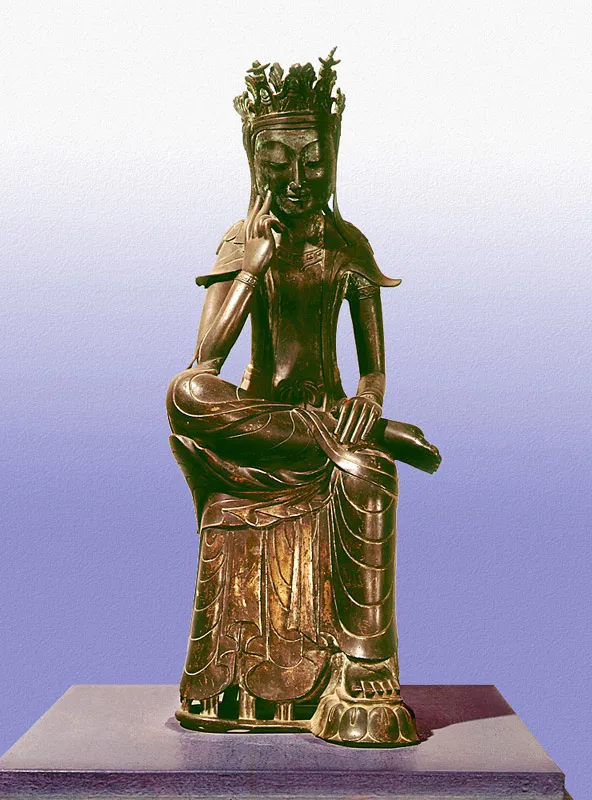
Gilt-bronze Pensive Maitreya Bodhisattva (1962-1)
金銅彌勒菩薩半跏思惟像(1962-1)
서울특별시 용산구
Basic information
- Designation
- National Treasure No.78
- Category
- Sculpture
- Era
- 삼국시대
- Designated year
- 1962
- Location
- 용산구, 서울특별시— 서울특별시 용산구 서빙고로 137 (용산동6가, 국립중앙박물관)
- Coordinates
- 37.524041, 126.980350
AI Docent
Coming soonAn AI-generated, friendly retelling of this heritage site is available in Korean. An English version is on our roadmap — for now, please see the official description below.
Description
This 80-centimeter high gilt-bronze pensive Maitreya Bodhisattva is seated on a stool-like pedestal with his right leg crossed over his left, the fingers of his right hand gently touching his cheek. It was acquired by a Japanese collector in 1912 and donated to the Japanese Government-General of Joseon before being turned over to its museum in 1916. Currently, the statue is on display at the National Museum of Korea. The bodhisattva is wearing a lavishly decorated headgear from which two strands are drawn over to both shoulders. He has a rather squarely, plump face wearing a benign smile and a sleek, imposing body with slender limbs and comparatively large hands and feet, all of which highlight his elegant physical appearance. He is clothed in a celestial veil robe that covers both shoulders before being draped down to cover the knees. The lower garment, made of a rather thick fabric, has many U-shaped folds exhibiting excellent workmanship. The oval pedestal on which the bodhisattva places his left leg is decorated with a lotus motif, but the mandorla (Buddhist halo of light) is missing. An X-ray inspection carried out in 1963 revealed that it has no trace of defect or repair either inside or out, and that it was made of a rare material using unique techniques. Art historians believe, based on the statue’s balanced physique, beautifully rendered robe folds, and pensive look, that it was made in the mid- or late 6th century during which the Korean style of bodhisattva images emerged.
Location
지도를 불러오는 중…
Have you visited this place?
Log in and verify your visit on-site via GPS to record a stamp in My Journey. (QR verification coming later.)
Images: KOGL (khs.go.kr) · Data source: Korea Heritage Service Open API (khs.go.kr)