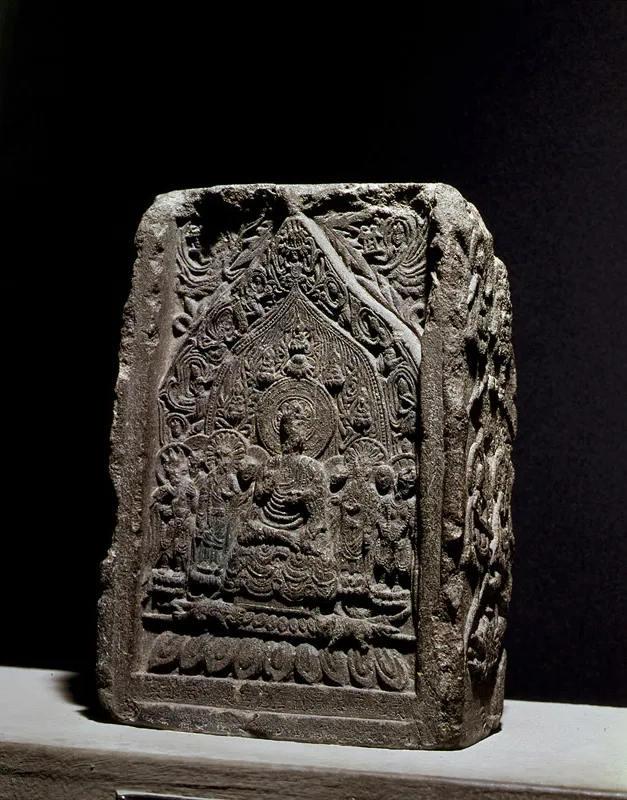
Buddhist Stele of Amitabha with Inscription of "Gyeyu Year"
癸酉銘全氏阿彌陀佛碑像
충청북도 청주시
Basic information
- Designation
- National Treasure No.106
- Category
- Sculpture
- Era
- 통일신라시대 초기
- Designated year
- 1962
- Location
- 청주시, 충청북도— 충청북도 청주시 상당구 명암로 143(명암동, 국립청주박물관)
- Coordinates
- 36.649664, 127.512008
AI Docent
Coming soonAn AI-generated, friendly retelling of this heritage site is available in Korean. An English version is on our roadmap — for now, please see the official description below.
Description
This Buddhist monumental stele discovered at Biamsa Temple in Yeongi-gun, Chungcheongnam-do, features a stone structure in the shape of a rectangular cuboid elaborately carved with Buddhist images and inscriptions on all of its four sides. The front face has a carved rectangular border containing an Amitabha Triad where the principal Buddha seated on a square pedestal put on a lotus seat features an oval face and robust build in a stable, comfortable sitting posture. The hands, displaying a gesture symbolizing Buddha giving a sermon, are comparatively large, showing an influence from the tradition of the Three Kingdoms Period (57 BCE – 668). The robe covers both shoulders and is draped far down to cover almost the entire pedestal while the mandorla the head consists of three concentric circles and lotus design contained in them. There are on both sides under the pedestal two lions. The two attending bodhisattvas flanking the Buddha are standing on lotus pedestals which are laid upon the back of the lions. Their faces are heavily damaged but have mandorlas decorated with lotus designs. There are faces of arhats between the bodhisattvas’ shoulders and the principal Buddha, and beside the bodisattvas two pairs of Vajrapani, divine guardians of Buddha and his law. There are behind the Buddha and his attendants two layers of aureoles embellished with flame design and the inner aureole contains five miniature Buddhist images. The area above the outer aureole is lowered further by carving to contain the images of the celestial maids called apsara. Each of the monument’s two sides is carved with a dragon head at the lower part and above the animal four musicians playing their instruments each on a lotus pedestal. The rear face is divided into four tiers each with five miniature Buddhas in seated position and between each two miniature images names and titles of those who were involved in the project of erecting this monument. The monument is often connected with the Monumental Stele of Buddha Triad and a Thousand Buddhas with Inscription of “Gyeyu Year” (National Treasure No. 108) in that both are lavishly decorated with elaborate carvings creating solemn beauty and maintain rare ancient artistic elements. Experts believe that the monument was set up in 673 after Silla won a series of wars which led to the unification of the three early Korean kingdoms.
Location
지도를 불러오는 중…
Have you visited this place?
Log in and verify your visit on-site via GPS to record a stamp in My Journey. (QR verification coming later.)
Images: KOGL (khs.go.kr) · Data source: Korea Heritage Service Open API (khs.go.kr)