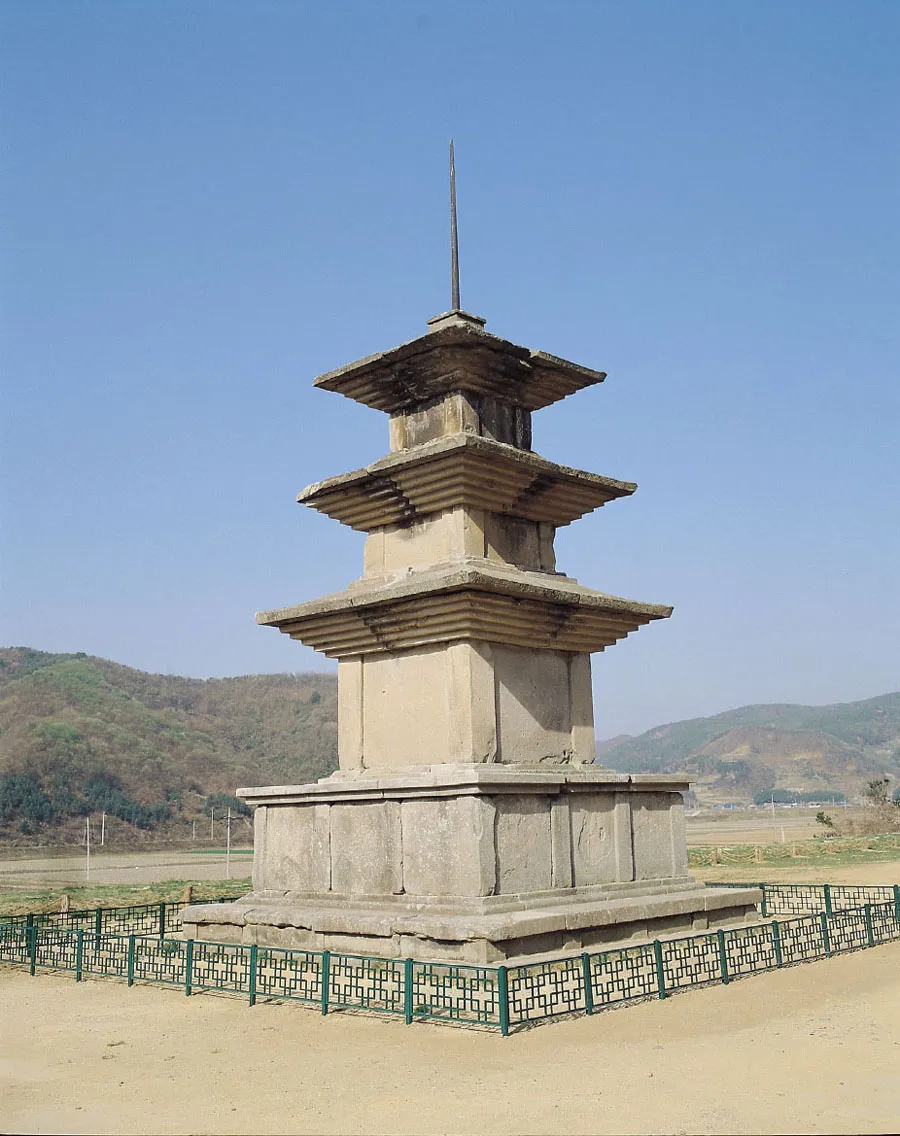
East and West Three-story Stone Pagodas at Gameunsa Temple Site, Gyeongju
慶州 感恩寺址 東·西 三層石塔
경상북도 경주시
Basic information
- Designation
- National Treasure No.112
- Category
- Sites & Pagodas
- Era
- 통일신라시대 7세기
- Designated year
- 1962
- Location
- 경주시, 경상북도— 경북 경주시 양북면 용당리 55-3, 55-9번지
- Coordinates
- 35.748140, 129.477007
AI Docent
Coming soonAn AI-generated, friendly retelling of this heritage site is available in Korean. An English version is on our roadmap — for now, please see the official description below.
Description
These twin pagodas, standing on a site once occupied by a historic Buddhist temple named Gameunsa, feature stone structures each of which consists of a double-tier base supporting a three-storied body. The pagodas show that Gameunsa is one of the first Silla temples that adopted a new architectural system established directly after the unification of the three ancient Korean kingdoms in the 7th century wherein a temple had two pagodas in its precincts but had only one under the old system. Gameunsa was established in this part of the southeastern coastal area by King Munmu (r. 661-681) who, having completed the unification of the three Korean kingdoms, wanted to strengthen the dignity of the kingdom -- and repel the Japanese pirates who disturbed its eastern coastal region so often -- by invoking magical intervention from Buddha. The king died before the completion of the temple, which was materialized in 682 when Silla was under the reign of his son, King Sinmun (r. 681-692). The Silla rulers’ yearning for the protection of their kingdom from foreign enemies is reflected on the twin pagodas’ imposing figures. One of the characteristic features of these pagodas is that, unlike most other stone pagodas made in the same period wherein each story is made of a single block of stone, each story is built by fitting a multiple number of stone blocks together. A major repair work done in 1960 led to the discovery of a gilt-bronze sarira reliquary (Treasure No. 366-1) and its matching gilt-bronze outer case (Treasure No. 366-2) on the West Three-story Stone Pagoda. These are the largest stone pagodas to have survived in Gyeongju today and are widely admired as majestic figures soaring high on a raised land against the East Sea.
Location
지도를 불러오는 중…
Have you visited this place?
Log in and verify your visit on-site via GPS to record a stamp in My Journey. (QR verification coming later.)
Images: KOGL (khs.go.kr) · Data source: Korea Heritage Service Open API (khs.go.kr)