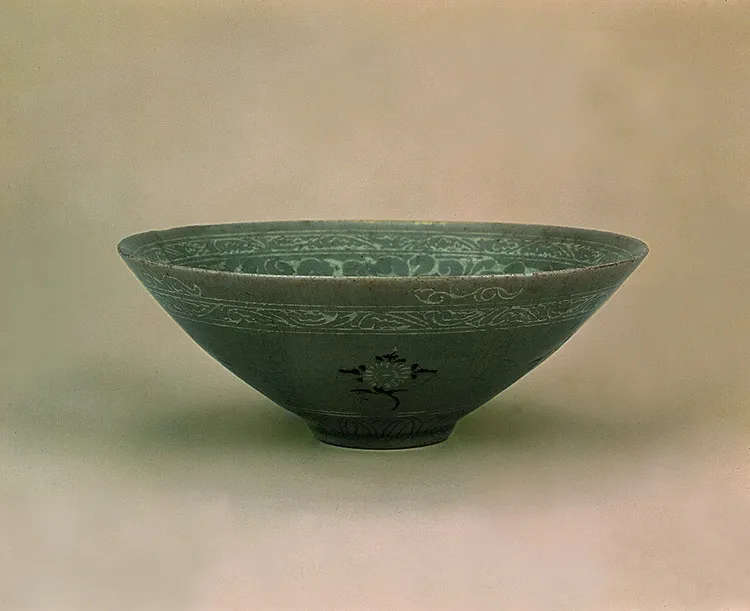
Celadon Bowl with Inlaid Scroll Design
靑磁 象嵌唐草文 碗
서울특별시 용산구
Basic information
- Designation
- National Treasure No.115
- Category
- Craft
- Era
- 고려시대(12세기)
- Designated year
- 1962
- Location
- 용산구, 서울특별시— 서울특별시 용산구 서빙고로 137 (용산동6가, 국립중앙박물관)
- Coordinates
- 37.524041, 126.980350
AI Docent
Coming soonAn AI-generated, friendly retelling of this heritage site is available in Korean. An English version is on our roadmap — for now, please see the official description below.
Description
This celadon bowl, made in the years when Goryeo reached the zenith in celadon art, has height of 6.05 centimeters, mouth dimension of 16.8 centimeters, and foot dimension of 4.4 centimeters. The bowl was excavated at the grave of Mun Gong-yu -- an eminent Goryeo official who died in 1159 -- in Gaepung-gun, Gyeonggi-do along with his memorial marker buried at the grave. It is the oldest existing Goryeo celadon ware decorated by the unique inlaying technique developed by Goryeo potters. The bowl is characterized by narrow foot, gently rounded sides, and widely everted large mouth. At the center of the inner bottom is a large circular flower motif rendered with the “reverse-inlaying” technique by which the central motif is highlighted by its background inlaid in white slip. The entire inner surface except the center and the edge is lavishly decorated with scroll motifs, also rendered by the same technique. Meanwhile, the outer surface features a band of foliage just below the mouth rim as well as chrysanthemum sprays on five points of the middle body, including flowers inlaid with white slip and stems and leaves with black. In addition to the contrast and balance between the decorative motifs and colors and inlaying techniques, the bowl is widely praised for the attractively translucent celadon glaze evenly coating the surface. It is also considered an important source of knowledge, containing ample information on the development of the inlaying technique by Goryeo potters during the mid-12th century.
Location
지도를 불러오는 중…
Have you visited this place?
Log in and verify your visit on-site via GPS to record a stamp in My Journey. (QR verification coming later.)
Images: KOGL (khs.go.kr) · Data source: Korea Heritage Service Open API (khs.go.kr)