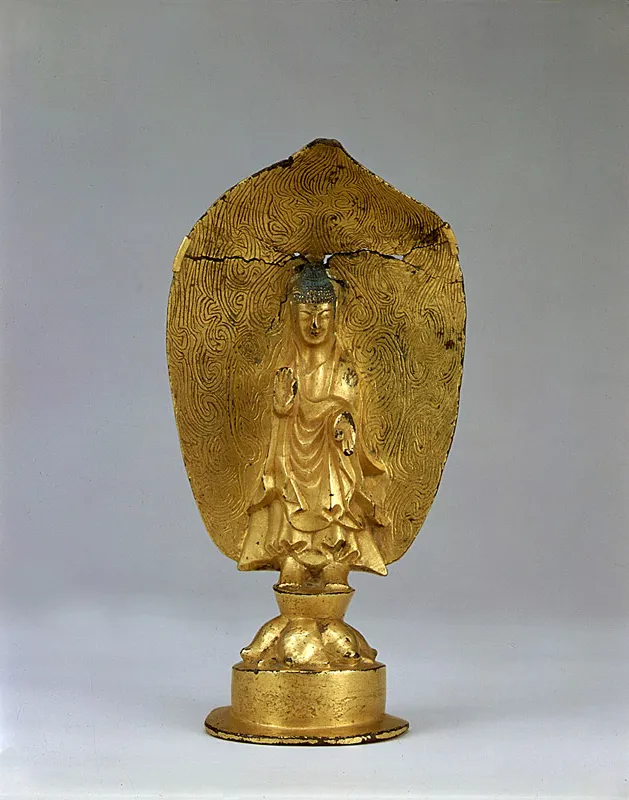
Gilt-bronze Standing Buddha with Inscription of "the Seventh Yeonga Year"
金銅延嘉七年銘如來立像
서울특별시 용산구
Basic information
- Designation
- National Treasure No.119
- Category
- Sculpture
- Era
- 삼국시대(고구려 6세기)
- Designated year
- 1964
- Location
- 용산구, 서울특별시— 서울특별시 용산구 서빙고로 137 (용산동6가, 국립중앙박물관)
- Coordinates
- 37.524041, 126.980350
AI Docent
Coming soonAn AI-generated, friendly retelling of this heritage site is available in Korean. An English version is on our roadmap — for now, please see the official description below.
Description
This Buddha image (height: 16.2cm) contains Chinese characters associated with the Goguryeo Period (circa 37 BC-668AD) including “延嘉,” which supposedly refers to the reign of King Anwon (r. 533-539). It was found in Uiryeong, Gyeongsangnam-do which used to be a territory of the Silla Dynasty. The inscriptions on the rear of the mandorla (Buddhist halo of light) of the Buddha image state that the image is the 29th of the 1,000 Buddha images made by monks at Dongsa Temple in Pyeongyang. The Buddha image displays a small turban shell-shaped tuft of hair stuck to the head, which is rarely found among those dating back to the Three Kingdom Period (circa 57BC-668AD), along with usnisa (a protuberance symbolizing supreme wisdom). Its small-sized face wears a smile and looks lean. It holds the right hand up with the palm facing the front. The fingers of the left hand, which is placed near the waist, point downward with the palm facing the front. The bent middle and ring fingers of the left hand are common in Buddha images dating back to the Three Kingdom Period. The very thick robe conceals the contours of the body. The overall body and the shape of the shoulder give the impression of toughness. The lower ends of the robe, which look like bird feathers, extend outward powerfully. Their sharp and powerful appearance shows the influence of the pattern of Northern Wei of China. The mandorla behind the Buddha image has the pattern of whirling flame in lines. The mandorla is partly damaged, but it is a rare Buddha image dating back to the Three Kingdom Period and whose gold plating remains in good condition. Researchers suppose that it is a piece made toward the end of the 6th Century based on the Chinese characters on the rear side of the mandorla, along with the powerful feeling exuded by it.
Location
지도를 불러오는 중…
Have you visited this place?
Log in and verify your visit on-site via GPS to record a stamp in My Journey. (QR verification coming later.)
Images: KOGL (khs.go.kr) · Data source: Korea Heritage Service Open API (khs.go.kr)