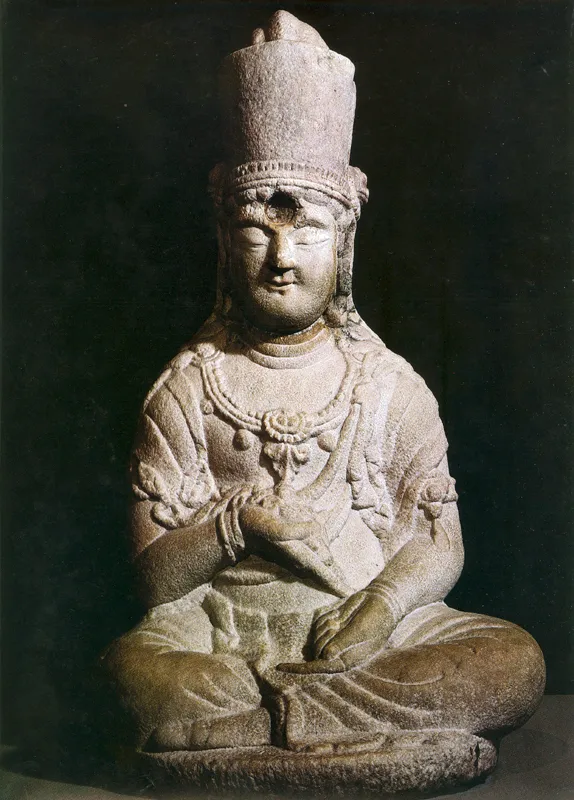
Stone Seated Bodhisattva from Hansongsa Temple Site, Gangneung
江陵 寒松寺址 石造菩薩坐像
강원특별자치도 춘천시
Basic information
- Designation
- National Treasure No.124
- Category
- Sculpture
- Era
- 고려시대
- Designated year
- 1967
- Location
- 춘천시, 강원특별자치도— 강원 춘천시 우석로 70, 국립춘천박물관 (석사동,국립춘천박물관)
- Coordinates
- 37.863981, 127.753878
AI Docent
Coming soonAn AI-generated, friendly retelling of this heritage site is available in Korean. An English version is on our roadmap — for now, please see the official description below.
Description
Originally kept at the Hansongsa Temple site, this piece was taken to Japan in 1912 and returned to Korea following the signing of the Korea-Japan Treaty on Basic Relations of 1965. It is in relatively good condition, except for the trace of reattaching the head torn off from the body and the white hair on the forehead, which is gone. The statue wears a very tall, cylinder-shaped crown, with usnisa (a protuberance symbolizing supreme wisdom) placed atop the crown. The square-shaped face wears a tender smile and has half-closed eyes. The neck shows three thick lines. A three-lined necklace hangs down to the chest. The robe is inscribed with wrinkles that look soft and natural. The right hand holds a lotus branch up to the chest. The left hand is placed on the thigh. The forefingers of both hands are fully extended outward. As for the position of the feet, the right foot is placed behind the left one. These foot positions are the opposite of its twin (Treasure No.81) found from the same temple. This statue, made of white marble, is distinguished from the other stone statues found in Korea, which are mostly made of granite stone. The texture of the material used, along with the sculpture technique, gives a graceful, warm impression. Overall, the body looks plump and exhibits mature and exquisite sculpture technique. The cylinder-shaped crown, the plump face, and the gentle smile are features shared by those of the Stone Seated Bodhisattva at Sinboksa Temple Site, Gangneung and Stone Seated Bodhisattva of Woljeongsa Temple, Pyeongchang (Treasure Nos. 84 and 139, respectively). Note, however, that this one exhibits a sculpture technique that is one notch higher than that of the former. This one was presumed to date back to the 10th Century during the early Goryeo Period (877-1392).
Location
지도를 불러오는 중…
Have you visited this place?
Log in and verify your visit on-site via GPS to record a stamp in My Journey. (QR verification coming later.)
Images: KOGL (khs.go.kr) · Data source: Korea Heritage Service Open API (khs.go.kr)