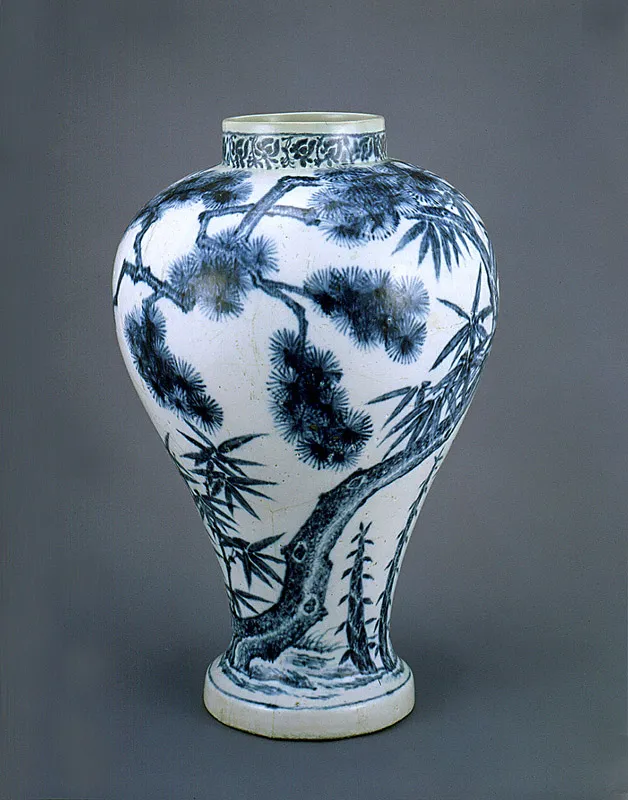
White Porcelain Jar with Pine and Bamboo Design and Inscription of "the Second Hongchi Year" in Underglaze Cobalt Blue
白磁 靑畵‘弘治二年’銘 松竹文 立壺
경기도 고양시
Basic information
- Designation
- National Treasure No.176
- Category
- Craft
- Era
- 조선시대
- Designated year
- 1974
- Location
- 고양시, 경기도— 경기도 고양시
- Coordinates
- 37.658429, 126.831978
AI Docent
Coming soonAn AI-generated, friendly retelling of this heritage site is available in Korean. An English version is on our roadmap — for now, please see the official description below.
Description
This porcelain jar was made in 1498 during the Joseon Dynasty under the reign of King Seongjong. It has a height of 14.7cm, mouth diameter of 13.1cm, and base diameter of 17.8cm. 1. The jar narrows a bit near the lip. 2. It has very soft and smooth lines reminiscent of the plum flower-type bottles made during the Goryeo Period. 3. A very thin middle section, much more confined than from the shoulder of the jar. 4. In contrast to the middle, it sharply widens from the middle. The Ewha Womans University Museum also holds a number of jars of the same kind, and they are registered as Treasure No. 644. It is supposed that this vase was used by those who performed various ceremonies at the King's Palace. Carved on top are lotus and creeper patterns, and pine is painted boldly on the rest. All the artwork is done carefully to promote realism. This jar was stolen twice while at Hwaeomsa Temple in Jirisan Mountain. Today, it is placed in a secure place at the Dongguk University Museum in Seoul. The inscription “Second year of the rule of King Hyojong Ming Dynasty in China, A.D. 1489” is an important historical proof marking the exact date that it was manufactured.
Location
지도를 불러오는 중…
Have you visited this place?
Log in and verify your visit on-site via GPS to record a stamp in My Journey. (QR verification coming later.)
Images: KOGL (khs.go.kr) · Data source: Korea Heritage Service Open API (khs.go.kr)