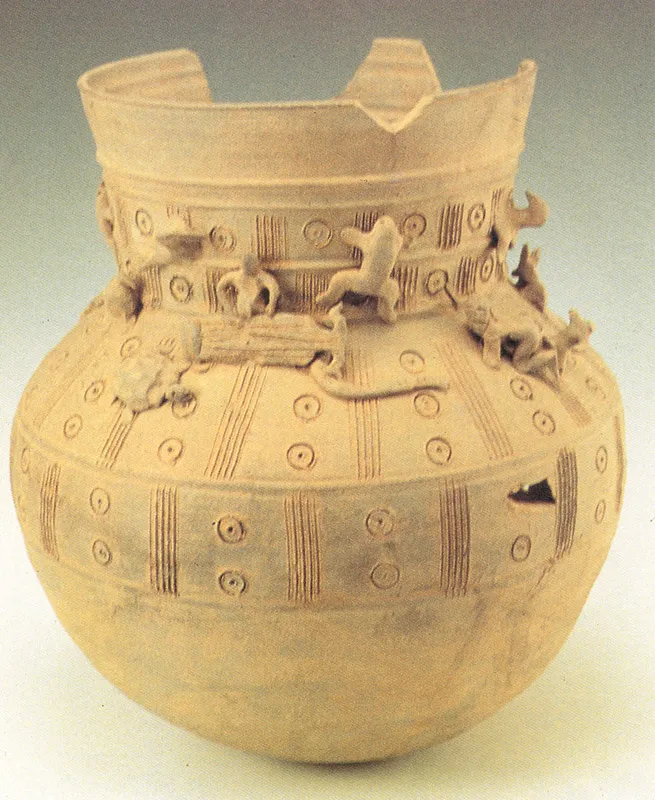
Long-necked Jar with Clay Figurines
土偶裝飾 長頸壺
경상북도 경주시
Basic information
- Designation
- National Treasure No.195
- Category
- Craft
- Era
- 신라시대
- Designated year
- 1978
- Location
- 경주시, 경상북도— 경상북도 경주시 일정로 186 (인왕동, 국립경주박물관)
- Coordinates
- 37.524041, 126.980350
AI Docent
Coming soonAn AI-generated, friendly retelling of this heritage site is available in Korean. An English version is on our roadmap — for now, please see the official description below.
Description
This doll is called tou (a doll made of clay) in Korean. Tous often represent the shapes of various animals, daily necessities, houses and people. There are multiple purposes for tou: as a toy, sorcery and burial. Though almost all of them were made from clay, some were made of bones, horns and even twigs. The first letter ‘to’ means clay or earth, and the last letter ‘u’ means a doll. A long-necked jar decorated with clay figurines discovered in Tomb No. 30 alongside Gyerim-ro is 34cm tall and 22.5cm in diameter at the mouth. Another long-necked jar was found in Tomb No. 11 in Nodong-dong Village. It is 40.5cm tall and 22.5cm in diameter at the mouth. 1) Characteristics of the Long-necked Jar from Tomb No. 30: 1. The four prominent stripes on the neck. 2. It is round on the bottom and forms a pout near the mouth.3. Five lines are on the body. 4. The body is divided the upper and lower parts. 5. The tou celebrate life: a man and woman engaging in a sexual intercourse, animals such as rabbits and snakes, and a woman, ripe with child, playing a traditional Korean instrument. These figures are attached to the dish's neck and shoulder area. Though damaged when discovered, this dish has been fully repaired to its original state. 2) The Long-necked Jar from Tomb No. 11 in Nodong-dong. The characteristic are as follows: 1. The mouth of the dish projects outward a little. 2. The neck is divided into two parts in terms of projective lines. 3. Five waves of lines are engraved on the neck. 4. The waves of lines are on the body as well. 5. There are a fewer number of dolls decorating the dish than the one mentioned above although the shape of the body is nearly the same. The production and use of these dolls were to fend off evil spirits. However, their simple yet emotional forms have given these dolls artistic value and historical meaning in addition to their religious use.
Location
지도를 불러오는 중…
Have you visited this place?
Log in and verify your visit on-site via GPS to record a stamp in My Journey. (QR verification coming later.)
Images: KOGL (khs.go.kr) · Data source: Korea Heritage Service Open API (khs.go.kr)