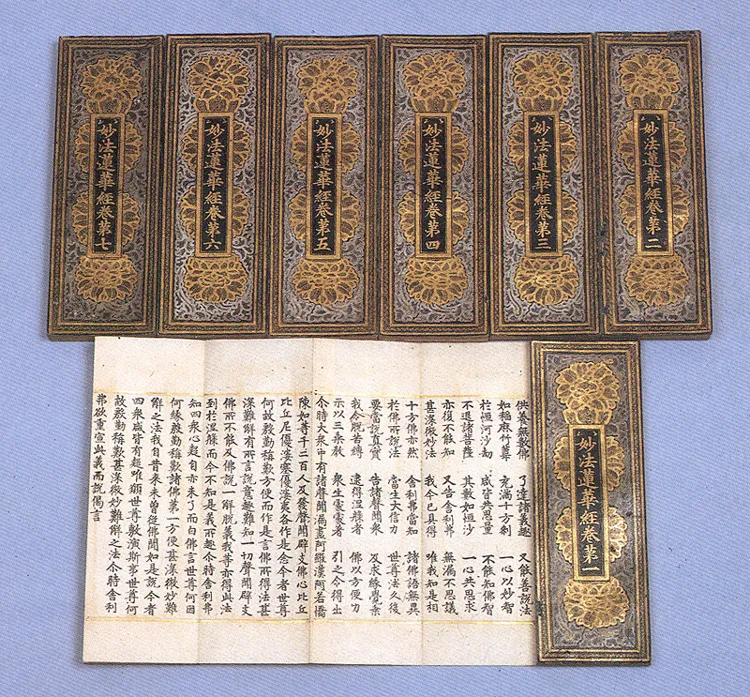
Transcription of Saddharmapundarika Sutra (The Lotus Sutra) in Ink on White Paper
白紙墨書 妙法蓮華經
서울특별시 관악구
Basic information
- Designation
- National Treasure No.211
- Category
- Books & Records
- Era
- 고려 우왕 3년(1377)
- Designated year
- 1984
- Location
- 관악구, 서울특별시— 서울 관악구 남부순환로152길 53, 호림박물관 (신림동,호림박물관)
- Coordinates
- 37.481072, 126.918352
AI Docent
Coming soonAn AI-generated, friendly retelling of this heritage site is available in Korean. An English version is on our roadmap — for now, please see the official description below.
Description
Saddharmapundarīka Sutra is often called by its shortened name the ‘Lotus Sutra.' It is the principal scripture for the T'ien-t'ai Sect. The main idea of the book is that the way to become a Buddha is be open to everybody. Along with the Avatamsaka Sutra, it has made a great influence in establishing Korean Buddhist philosophy. It is the most widely circulated Buddhist scripture since the Period of Three Kingdoms. This book contains the seven volumes of the Lotus Sutra translated by Kumārajiva of the Late Chin of China. The scripture was carefully hand-copied by Ha Deokran in 1377 (the 3rd year of King U of Goryeo) with a prayer for longevity of his father and soul of his deceased mother. The contents were written in ink on white mulberry papers. Each volume is made in the form of a folding screen 10.9cm long and 31.8cm wide. On the cover of each volume is a magnificent picture of flowers painted in gold and silver. The title of each book is also written on it in gold. At the beginning of each book is a detailed painting of the summary of the content colored in gold. From a remark left at the end of the book by a Japanese we can tell that this book had been taken to Japan around 1443 (the 25th year of King Sejong of Joseon) and kept in the royal storage of Gwangdaewon since 1605 (the 38th year of King Seonjo). This book contains both the writings that tell the reason why this was produced and the painting that summarizes the content. It has been kept in a relatively good condition. In particular, having been recovered from Japan, it is considered as a valuable cultural asset.
Location
지도를 불러오는 중…
Have you visited this place?
Log in and verify your visit on-site via GPS to record a stamp in My Journey. (QR verification coming later.)
Images: KOGL (khs.go.kr) · Data source: Korea Heritage Service Open API (khs.go.kr)