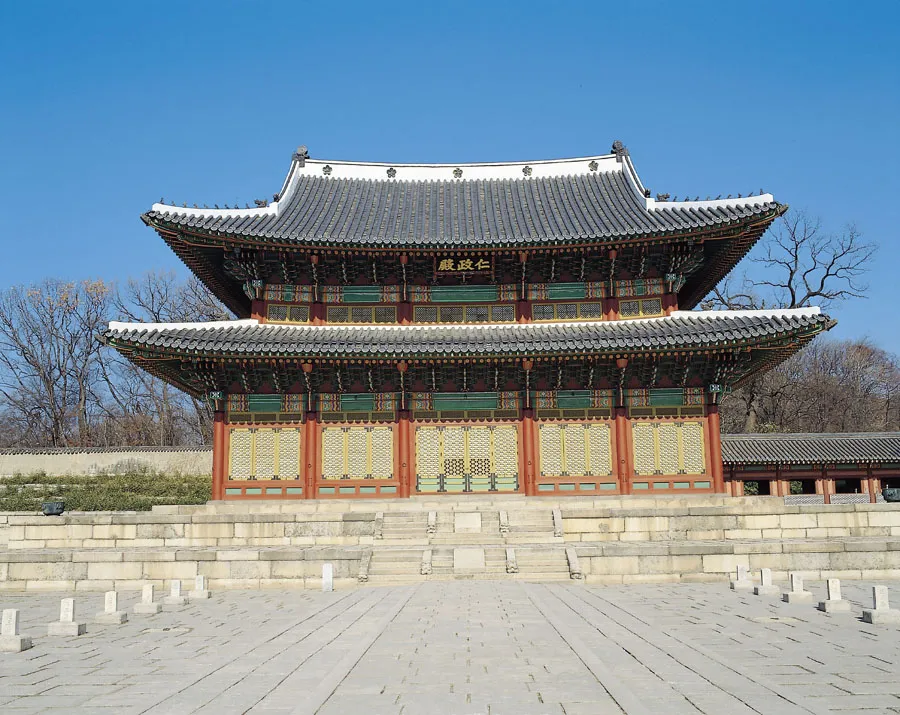
Injeongjeon Hall of Changdeokgung Palace
昌德宮 仁政殿
서울특별시 종로구
Basic information
- Designation
- National Treasure No.225
- Category
- Architecture
- Era
- 조선 순조 4년(1804)
- Designated year
- 1985
- Location
- 종로구, 서울특별시— 서울 종로구 율곡로 99, 창덕궁 (와룡동)
- Coordinates
- 37.579379, 126.991100
AI Docent
Coming soonAn AI-generated, friendly retelling of this heritage site is available in Korean. An English version is on our roadmap — for now, please see the official description below.
Description
Injeongjeon is the main hall of Changdeokgung Palace. The officials assembled here to wish the King a Happy New Year. Kings conducted state affairs, held national ceremonies and received foreign officials. It was equipped with various decorations that symbolized the formality and diplomacy of the palace in the Joseon Dynasty. On either side of the building, there are corridors with roofs, with the ground containing the stones indicating the rank of officials. When the Crown Prince was proclaimed, or there was a national celebration, the king was congratulated by the officials in Injeongjeon. It was firstly built along with Changdeokgung Palace in 1405 (the 5th year of King Taejong). It had been repaired several times and the present state of the building was built in 1804 (the 4th year of King Sunjo). Injeongjeon was occupied with 5 bays(kans) in the front and 4 bays(kans) in the side. The roofs are in '八' shape. It was erected on the two-story platform. In the center of the ceiling, two sculptures of a phoenix are hanging. Behind the high pillars in the middle, the throne is placed. Behind the throne, there is a folding screen with the painting of Irwoloakdo (The Sun, the Moon and the Five Peaks. The top of the roof was decorated with a plum design, which was a symbol of an imperial family during the very end of the Joseon Dynasty. Injeongjeon, one of the three great halls along with Geunjeongjeon in Gyeongbokgung Palace and Myeongjeongjeon in Changgyeonggung Palace, was the main place that represents the history of the Joseon Dynasty.
Location
지도를 불러오는 중…
Have you visited this place?
Log in and verify your visit on-site via GPS to record a stamp in My Journey. (QR verification coming later.)
Images: KOGL (khs.go.kr) · Data source: Korea Heritage Service Open API (khs.go.kr)