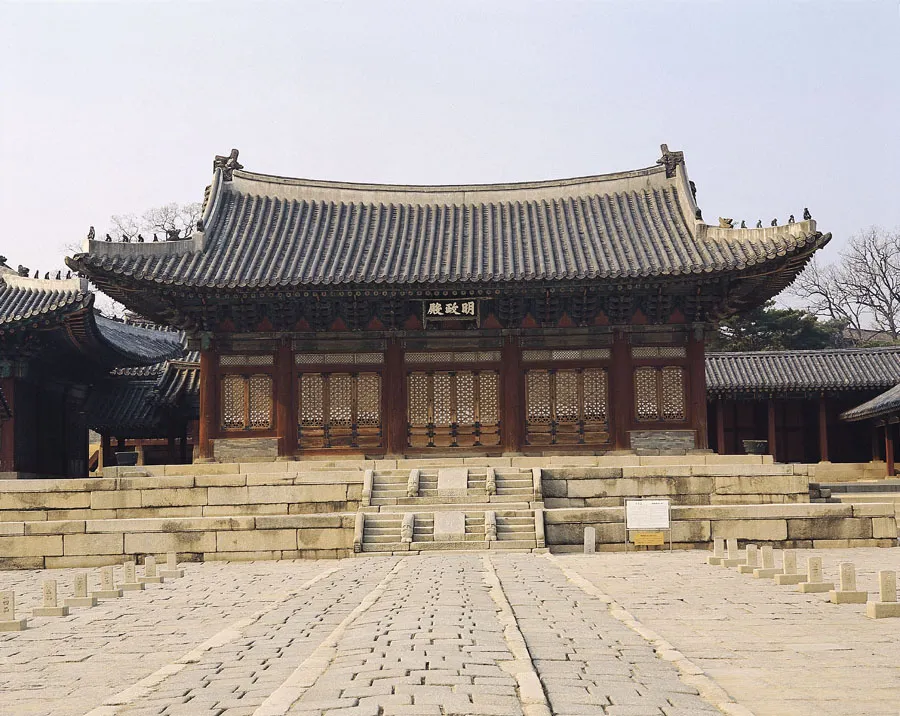
Myeongjeongjeon Hall of Changgyeonggung Palace
昌慶宮 明政殿
서울특별시 종로구
Basic information
- Designation
- National Treasure No.226
- Category
- Architecture
- Era
- 조선 광해군 8년(1616)
- Designated year
- 1985
- Location
- 종로구, 서울특별시— 서울특별시 종로구 창경궁로 185 (와룡동, 창경궁)
- Coordinates
- 37.578748, 126.995008
AI Docent
Coming soonAn AI-generated, friendly retelling of this heritage site is available in Korean. An English version is on our roadmap — for now, please see the official description below.
Description
Myeongjeongjeon is the main building in Changgyeonggung Palace. The officials assembled here to wish the King a Happy New Year. Kings conducted state affairs, held national ceremonies and received foreign officials. It was built in 1484 (the year of King Seongjong of Joseon Dynasty), but it was reconstructed in 1616 (the year of King Gwanghaegun) after being burnt down during the Japanese Invasion in 1592. While the Geunjeongjeon in Gyeongbokgung Palace and Injeongjeon in Changdeokgung Palace are large two-story buildings, Myeongjeongjeon is a small single-story building. It is relatively smaller for it was built as a residence of the Queen’s mother. It contains 5 rooms in the front and 3 rooms in the side, while the roofs are '八' shaped. Pillars and supporting the eaves were not only placed on the top of the pillars but also between pillars, called the multi-beam style. They were soundly constructed without decoration. It was typical style of the early Joseon Dynasty with it vigorously constructed and well balanced. The inside of the floor was covered with the stones. Behind the throne, there was a folding screen named Irwoloakdo which was embroidered figures of the sun, the moon, and the five famous mountains in Korea. In front of the stairs outside the building, there were 24 platforms, indicating the rankings of the government officials. Although it was rebuilt after the Japanese Invasion of Korea in 1592, it represented the style of the early Joseon Dynasty, and it has been considered as a valuable cultural asset for the history of architecture.
Location
지도를 불러오는 중…
Have you visited this place?
Log in and verify your visit on-site via GPS to record a stamp in My Journey. (QR verification coming later.)
Images: KOGL (khs.go.kr) · Data source: Korea Heritage Service Open API (khs.go.kr)