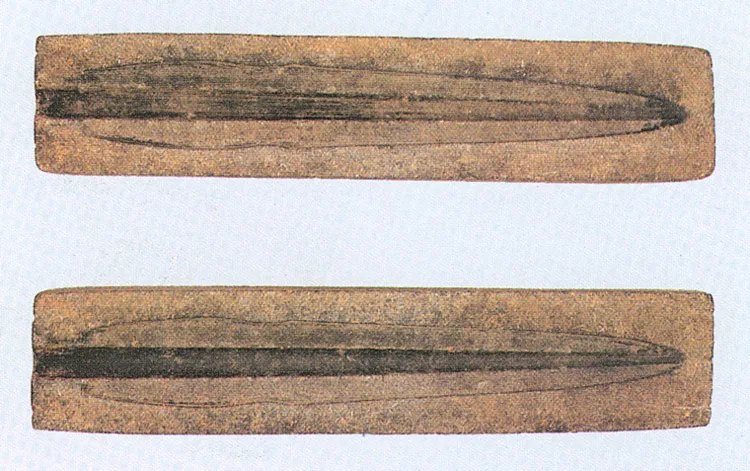
Bronze Age Moulds from Yeongam (Presumed)
傳 靈巖 鎔范一括
서울특별시 동작구
Basic information
- Designation
- National Treasure No.231
- Category
- Craft
- Era
- 청동시대 후기
- Designated year
- 1986
- Location
- 동작구, 서울특별시— 서울 동작구 상도로 369, 한국기독교박물관 (상도동,숭실대학교)
- Coordinates
- 37.507380, 126.952128
AI Docent
Coming soonAn AI-generated, friendly retelling of this heritage site is available in Korean. An English version is on our roadmap — for now, please see the official description below.
Description
The molds called yongbeom, geopujip or juhyeong in Korean, from the Bronze Age were used to cast bronze tools and weapons. Historically, it is known that ancient Europeans used molds made of stone and clay while ancient Indians and Egyptians developed a method using wax in casting their tools. In China, a variety of molding techniques were developed during the era of Longshan Culture, around 2000 BC. As seen by the relics found in Yeongam-gun of Jeollanam-do, ancient Koreans favored stone molds. The molds are said to have been excavated just after Korea became an independent country in 1945. Sadly, no details of the excavation are known. 1) Bronze Dagger Mold. Two of these molds were used to make a dagger. The shape of one side (as seen here) is 34.5cm in width, 7.4cm in length, and 4cm in height. The actual length of a knife able to be manufactured by this mold is 33cm. Because this mold has been heavily used, it has been burned black and parts of it have fallen in slightly. 2) Bronze Dagger and Spear Mold. One face of this mold was used for making sehyeongdonggeom (copper knife) and the other for producing donggwa (javelin). When the two faces are used together, they form a spear. The size of one side is 35.5cm in width, 8.8cm in length, and 4.1cm in height. For it was used heavily, all parts of the geom (knife) and gwa (javelin) mold are scorched black. 3) Bronze Axe, Hatchet and Chisel Mold. This is also supposed to have been employed by putting together opposing sides. This was manufactured for making three tools: one face was for dokki or dongbu (axe shaped in a form of a circle), and the other face made kkeul or chak (chisel) and jagwi or sodongbu (small sized axe). Metal rings were attached to the circular axe and the small sized axes and chisels were tools for work. 4) Bronze Axe and Hook Mold. This is a mold for making axes having a blade shaped in the form of a fan. It consists of two sides, one frame molding for hooks called jochim or naksibaneul and needles called baneul or chim. The frames of the hook and needles for this particular mold must not have been used at all for there are no burnt traces around the frames. In contrast, the frame for a copper axe has some burnt tracks around it. 5) Bronze Hatchet and Hook Mold. This is also supposed to have been used in making small knives. It consists of two faces, and the size of one face is 11.93cm in width, 7.05cm in length, and 2.17cm in height. The back of one of the faces also produced a pair of hooks and two isolated hooks. The back of the other face, had it been completed, would have made a mirror frame having fine comb patterns called danyusemungyeong. The failure to make mirrors having fine comb patterns has many experts believe that this mold must have been used in producing copper axes called dongbu. This particular hook frame does not show any visible scars from burning, indicating that it was not used. 6) Bronze Hatchet and Chisel Mold. The bronze hatchet and chisel mold also consists of two sides: one for producing a small axe called jagwi and the other for two chisels called kkeul. The hook matrix attaching a hook called jochim or naksibaneul and needles called baneul or chim. The frames of the hook and needles for this particular mold must not have been used at all for there are no burnt traces around the frames. In contrast, the frame for a coffer axe has some burnt tracks around it. 5) Bronze Hatchet and Hook Mold. This is also supposed to have been used in manufacturing a small sized knife. It consists of two faces, and the size of one face is 11.93cm in width, 7.05cm in length, and 2.17cm in height. The back of one of the faces also produced a pair of hooks and two isolated hooks. The back of the other face, had it been completed, would have made a mirror frame having fine comb patterns called danyusemungyeong. The failure to make mirrors having fine comb patterns has many experts believe that this mold must have been used in producing copper axes called dongbu. This particular hook frame does not show any visible scars from burning, indicating that it was not used. 6) Bronze Hatchet and Chisel Mold. The bronze hatchet and chisel mold also consists of two sides: one for producing a small axe called jagwi and the other for two chisels called kkeul. The hook matrix attached to both sides of the frame was also used for making needles. 7) Bronze Dagger and Spear Mold. There is only one face. One one side of the face, the mold made copper spears called dongmo and the other side produced knives made of coffer and having many fine comb patterns. It is 20.2cm wide, 7.45cm long and 2.43cm high) Bronze Dagger, Spear and Needle Mold. This must have been used in manufacturing sehyeong donggeom yongbeom, coffer knives having soft comb patterns on one face and in making frames for producing needles, chimyongbeom, and copper spears, dongsa or cheongdongchang. These molds were made of steatite and regarded as one of the most precious molds discovered in Korea.
Location
지도를 불러오는 중…
Have you visited this place?
Log in and verify your visit on-site via GPS to record a stamp in My Journey. (QR verification coming later.)
Images: KOGL (khs.go.kr) · Data source: Korea Heritage Service Open API (khs.go.kr)