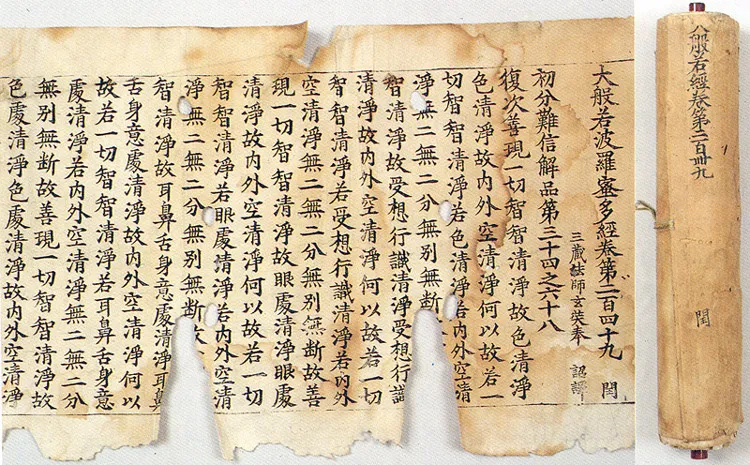
Maha prajnaparamita Sutra (Perfection of Transcendental Wisdom), the First Tripitaka Koreana Edition, Volume 249
初雕本 大般若波羅蜜多經 卷二百四十九
서울특별시 용산구
Basic information
- Designation
- National Treasure No.241
- Category
- Books & Records
- Era
- 고려 현종 연간
- Designated year
- 1988
- Location
- 용산구, 서울특별시— 서울특별시 용산구 서빙고로 137 (용산동6가, 국립중앙박물관)
- Coordinates
- 37.523500, 126.980100Museum-based location
AI Docent
Coming soonAn AI-generated, friendly retelling of this heritage site is available in Korean. An English version is on our roadmap — for now, please see the official description below.
Description
Daebanyabaramil Dagyeong is often called Daebanyagyeong or simply Banyagyeong in a shortened form. The main idea in this Buddhist scripture is emptiness, a thought that one should get rid of obsession because there is no substance in a being itself. This scripture is often called Banyasimgyeong in Korea and chanted by every Buddhist regardless of his or her sect. This book is a part of the Tripitaka Original, which was made during the reign of King Hyeonjong (1011~1031) of the Goryeo Period in an attempt to counter an aggression by Kitan on the strength of Buddha. It is Book No. 249 among the six hundred books of Daebanyagyeong translated by Hyeonjang, a famous monk during the Tang Dynasty of China. It is produced by woodblock printing on 23 pieces of mulberry papers joined together in a row and designed to be stored in the form of a scroll. Each page is 49.5~51cm long and 29.1cm wide. There are several differences between the Tripitaka Original and the Tripitaka at Haeinsa Temple (also known as the Tripitaka Second or the Tripitaka Koreana), which were produced later. The former has more sophisticatedly carved woodblocks than the latter. It has a different number of characters, while not showing the year of production. Respect is expressed by omitting a stroke from the letter or replacing it with a synonymous word when a letter in the name of the preceding king appears, and abbreviated characters are found in several places. In addition, the Tripitaka Original often uses the words 'jang (丈)' and 'pok (幅)' to indicate the chapters in the books, whereas the Haeinsa Temple version uses a uniform expression of 'jang (張)' (using a different Chinese character). The condition of the printing as well as the quality of the papers implies that this is printed between the 11th and the 12th century when the Tripitaka Original is produced. This is the earliest copy of The First Edition of the Banyagyeong kept in Korea.
Location
지도를 불러오는 중…
Have you visited this place?
Log in and verify your visit on-site via GPS to record a stamp in My Journey. (QR verification coming later.)
Images: KOGL (khs.go.kr) · Data source: Korea Heritage Service Open API (khs.go.kr)