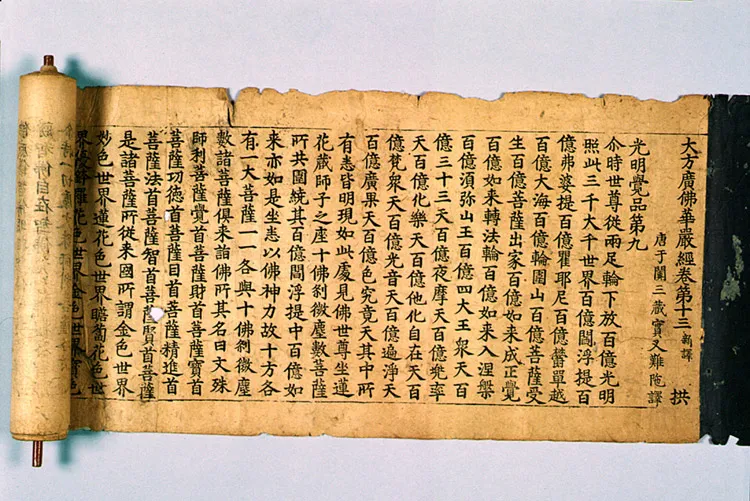
Avatamsaka Sutra (The Flower Garland Sutra), Zhou Version, the First Tripitaka Koreana Edition, Volume 13
初雕本 大方廣佛華嚴經 周本 卷十三
서울특별시 종로구
Basic information
- Designation
- National Treasure No.265
- Category
- Books & Records
- Era
- 고려시대(11세기)
- Designated year
- 1991
- Location
- 종로구, 서울특별시— 서울특별시 종로구
- Coordinates
- 37.572950, 126.979358
AI Docent
Coming soonAn AI-generated, friendly retelling of this heritage site is available in Korean. An English version is on our roadmap — for now, please see the official description below.
Description
Daebanggwangbul Avatamsaka Sutra is also called by its shortened name the Avatamsaka Sutra. Along with the Lotus Sutra, this principal scripture of the Avatamsaka Sutra is one of the books that have the greatest influence in the establishment of Korean Buddhist philosophy. This is Book No. 13 among the 80 books of the original edition of the Avatamsaka Sutra translated by Sikṣānanda of the Tang Dynasty of China. It is a part of the Tripitaka Original, which was made during the reign of King Hyeonjong (1011-1031) of the Goryeo Period in an attempt to counter an aggression by Kitan on the strength of Buddha. The book is produced by woodblock printing on mulberry papers and designed to be stored in the form of a scroll. It is made by joining in a row 24 pieces of papers, each of which is 46.3cm long and 28.5cm wide. There are several differences between the Tripitaka Original and the Tripitaka at Haeinsa Temple (also known as the Tripitaka Second or the Tripitaka Koreana), which were produced later. The former has more sophisticatedly carved wood blocks than the latter. It contains a smaller number of characters, while not showing the year of production. Pihwi, a way of expressing respect by omitting a stroke from the letter or replacing it with a synonymous word when a letter in the name of the preceding king appears, and abbreviated characters are found in several places. In addition, the Tripitaka Original often uses the words 'jang (丈)' and 'pok (幅)' to indicate the chapters in the books, whereas the Haeinsa Temple version uses a uniform expression of 'jang (張)' (using a different Chinese character). The number of characters in a line in this book is only fourteen, while each line contains seventeen characters in the Haeinsa Temple version. The last stroke in the character 'gyeong (竟)' is omitted. The condition of the printing as well as the quality of the papers suggests that, just like Books No. 1 (National Treasure No. 256), 29 (National Treasure No. 257) and 74 (National Treasure No. 279) of The First Edition of the Main Edition of Daebanggwangbul Avatamsaka Sutra, this book is published sometime between the 11th and 12th century, when the Tripitaka Original is made.
Location
지도를 불러오는 중…
Have you visited this place?
Log in and verify your visit on-site via GPS to record a stamp in My Journey. (QR verification coming later.)
Images: KOGL (khs.go.kr) · Data source: Korea Heritage Service Open API (khs.go.kr)