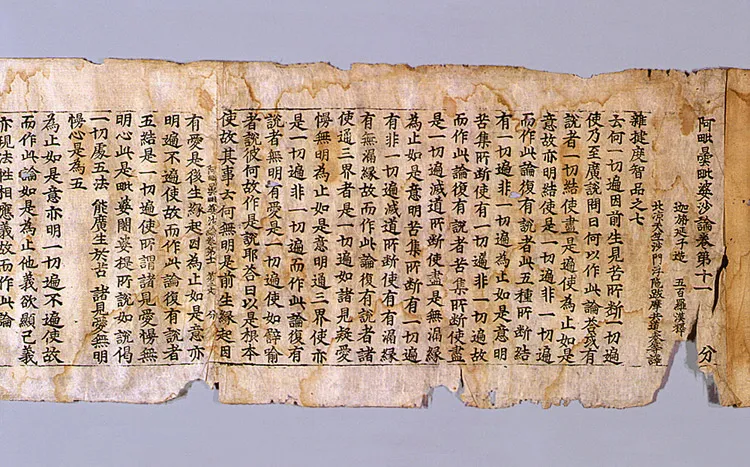
Abhidharma vibhasa Sastra (Explanatory of the Abhidharma), the First Tripitaka Koreana Edition, Volumes 11 and 17
初雕本 阿毗曇毗婆沙論 卷十一, 十七
서울특별시 관악구
Basic information
- Designation
- National Treasure No.268
- Category
- Books & Records
- Era
- 고려시대(12세기)
- Designated year
- 1991
- Location
- 관악구, 서울특별시— 서울 관악구 남부순환로152길 53, 호림박물관 (신림동,호림박물관)
- Coordinates
- 37.481072, 126.918352
AI Docent
Coming soonAn AI-generated, friendly retelling of this heritage site is available in Korean. An English version is on our roadmap — for now, please see the official description below.
Description
In general, the Buddhist scriptures can be divided into three groups: bible, commandments and theories. The Abidam is the theoretical part of the scriptures that provides a systematic explanation of the wisdom of Buddha. The Theory of Abidambibasa provides a systematic guide to Buddha's wisdom needed for the living things to practice to enter Nirvana. These are Books No. 11 and 17 among the 60 books jointly translated by Butabalma and Dotae of the North Riang. They are a part of the Tripitaka Original, which was made during the reign of King Hyeonjong (1011~1031) of the Goryeo Period in an attempt to counter an aggression by Kitan on the strength of Buddha. They are produced by woodblock printing on mulberry papers and designed to be stored in the form of a scroll. Book No. 11 is made by joining in a row 46 pieces of papers, each of which is 47.8cm long and 28.9cm wide. Book No. 17, on the other hand, is made by joining in a row 37 pieces of papers, each of which is 47.4cm long and 29.7cm wide. There are several differences between the Tripitaka Original and the Tripitaka at Haeinsa Temple (also known as the Tripitaka Second or the Tripitaka Koreana), which were produced later. The former has more sophisticatedly carved wood blocks than the latter. It has a different number of characters, while not showing the year of production. Respect is expressed by omitting a stroke from the letter or replacing it with a synonymous word when a letter in the name of the preceding king appears, and abbreviated characters are found in several places. In addition, the Tripitaka Original often uses the words 'jang (丈)' and 'pok (幅)' to indicate the chapters in the books, whereas the Haeinsa Temple version uses a uniform expression of 'jang (張)' (using a different Chinese character). The chapters in this book are expressed in terms of 'jang (丈)'. The year of production is not found at the end of the book. The last stroke in all Chinese characters that are pronounced 'gyeong (竟)', the first letter in the preceding king's name, is omitted. All these imply that this book is a woodblock print of the Tripitaka Original and the condition of the printing as well as the quality of the papers tells that it made around the 12th century.
Location
지도를 불러오는 중…
Have you visited this place?
Log in and verify your visit on-site via GPS to record a stamp in My Journey. (QR verification coming later.)
Images: KOGL (khs.go.kr) · Data source: Korea Heritage Service Open API (khs.go.kr)