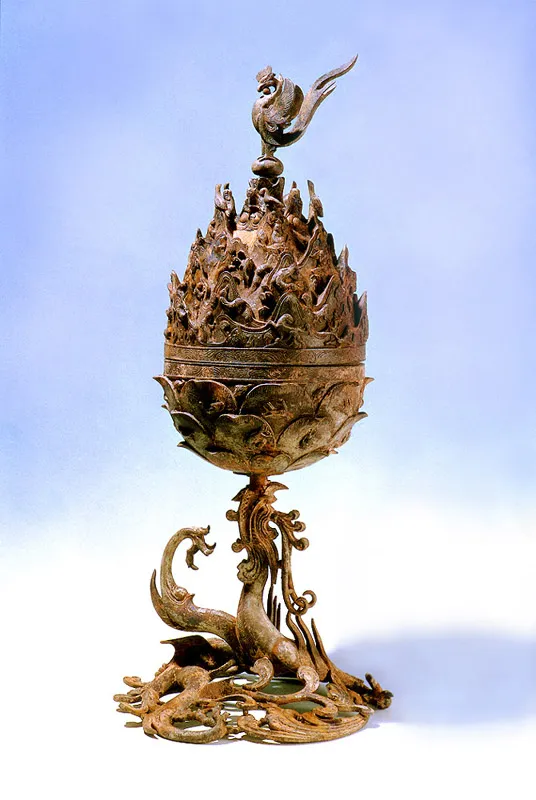
Great Gilt-bronze Incense Burner of Baekje
百濟 金銅大香爐
충청남도 부여군
Basic information
- Designation
- National Treasure No.287
- Category
- Craft
- Era
- 백제시대(6∼7세기)
- Designated year
- 1996
- Location
- 부여군, 충청남도— 충남 부여군 부여읍 금성로 5, 국립부여박물관 (동남리,국립부여박물관)
- Coordinates
- 36.276363, 126.918989
AI Docent
Coming soonAn AI-generated, friendly retelling of this heritage site is available in Korean. An English version is on our roadmap — for now, please see the official description below.
Description
This is a large incense burner 64cm in height and 11.8 kilograms in weight. This artifact was excavated in 1993 at the temple site near Naseong Fortress of Baekje and the ancient tombs in Neungsan-ri with the help of the Buyeo National Museum. It was excavated along with 450 other artifacts. There are four parts to this incense burner. The body and the lid are the main parts. The Chinese phoenix-shaped knob and the support plate are two other parts. There is scenery of 23 mountains shaping four to five layers of deep-mountain ranges on the lid. Five musicians with various instruments and sixteen other various characters are also illustrated. Thirty-nine animals including the Chinese phoenix, dragon, tiger, and deer are depicted. Six different trees, twelve boulders, trails, creeks, waterfalls, lakes, and other land features compose changing scenery. On top of the lid, a separate Chinese phoenix holding yeouiju between its beak and neck is mounted. It is standing up with its wings folded and tail raised. Such smoothness is a characteristic of Baekje Dynasty's artwork. Five holes are drilled on the lid, including one on the chest of the Chinese phoenix, to naturally ventilate the incense flow. The main body of the burner closely resembles a blossoming lotus flower. On the lateral surface, twenty-six different animals are depicted. The supporting plate is a dragon holding a blossoming lotus flower, which is the main body, with its mouth pointing upward. It appears that this incense burner was influenced by a Chinese version called Baksan Incense Burner, but unlike the Chinese ones, the design of the scenery is independent, three-dimensional, and realistic. The creativity and modeling is superb, and the illustration of Buddhism, Taoism, and other religious theology and beliefs demonstrates its complexity.
Location
지도를 불러오는 중…
Have you visited this place?
Log in and verify your visit on-site via GPS to record a stamp in My Journey. (QR verification coming later.)
Images: KOGL (khs.go.kr) · Data source: Korea Heritage Service Open API (khs.go.kr)