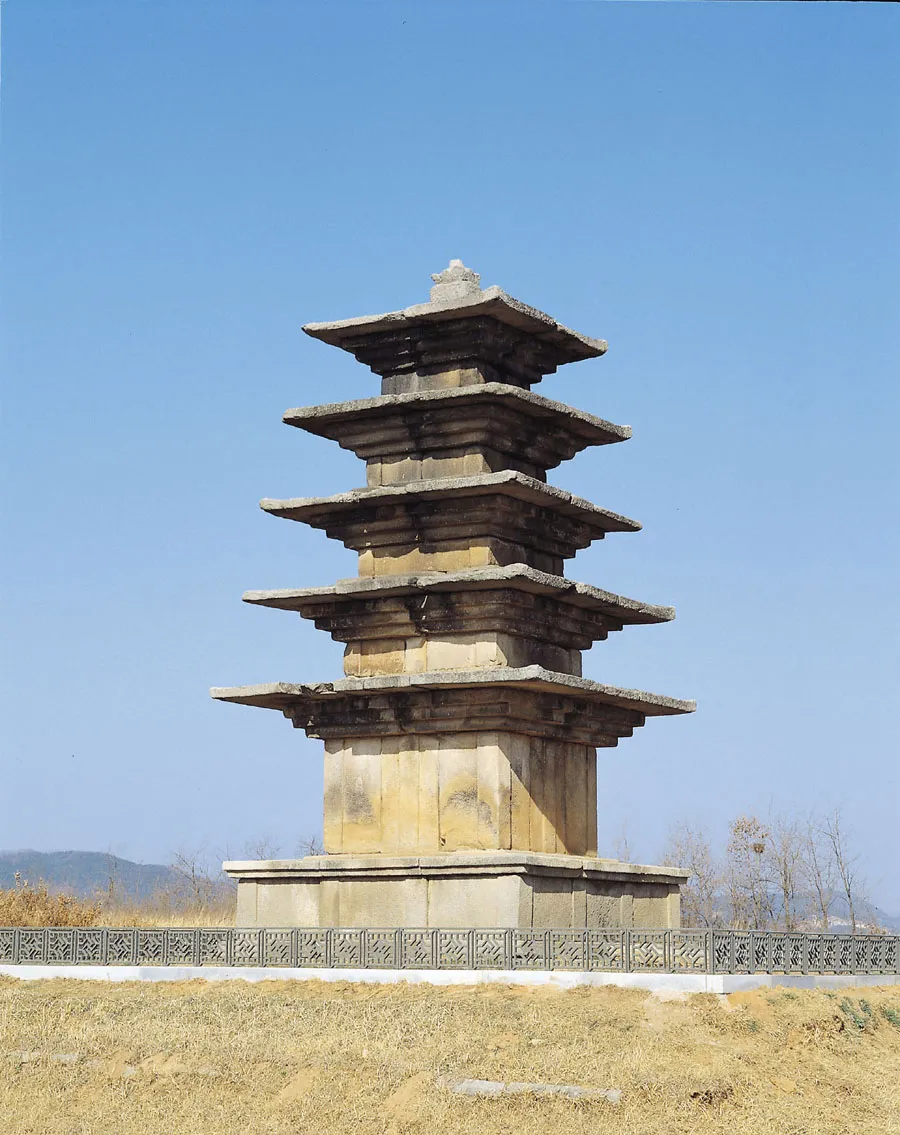
Five-story Stone Pagoda in Wanggung-ri, Iksan
益山 王宮里 五層石塔
전북특별자치도 익산시
Basic information
- Designation
- National Treasure No.289
- Category
- Sites & Pagodas
- Era
- 고려시대
- Designated year
- 1997
- Location
- 익산시, 전북특별자치도— 전북 익산시 왕궁면 왕궁리 산80-1번지
- Coordinates
- 35.973125, 127.054584
AI Docent
Coming soonAn AI-generated, friendly retelling of this heritage site is available in Korean. An English version is on our roadmap — for now, please see the official description below.
Description
This Five-story Stone Pagoda is located on a hill, about 2 km south of Wanggung-myeon, Iksan, which is known as the capital of Mahan. This pagoda consists of five stories, a single-tier foundation and some of the final. The foundation had been buried in the ground before it was dismantled and restored to the present shape in 1965. At each corners of the foundation is installed an octagonal corner stone serving as a corner column, between which long, square stones are piled up in imitation of wooden pagodas. The inside of the columns and stones is filled with earth, in which fragments of Baekje roof tiles are discovered. During the 1965 repair work, a sarira container was retrieved inside the base and the roof of the first story. The repair work also revealed a new fact that two central pillars are carved on each side of the foundation. Each story has a column at all corners, and the first story has two central pillars engraved on all sides. The thin, flat roofs are slightly upturned at the corners. The marks on the corners of the eaves suggest that wind-bells hung there. Each roof has a supporting stone on its top to hold the superstructure. Of the final, a stone base, an upside-down alms bowl, an upward-looking flower and a partly broken ring remain. The roofs retain characteristics of Baekje pagodas to some extent, which led to a controversy over the exact date of the pagoda's construction. Judging from the composition style of the foundation and the retrieved sarira container, this pagoda seems to have been the work of early Goryeo, which combines the styles of both Baekje and Silla pagodas. The relics retrieved during the 1965 repair work are designated as National Treasure No. 123 and are on display at the National Museum of Korea.
Location
지도를 불러오는 중…
Have you visited this place?
Log in and verify your visit on-site via GPS to record a stamp in My Journey. (QR verification coming later.)
Images: KOGL (khs.go.kr) · Data source: Korea Heritage Service Open API (khs.go.kr)